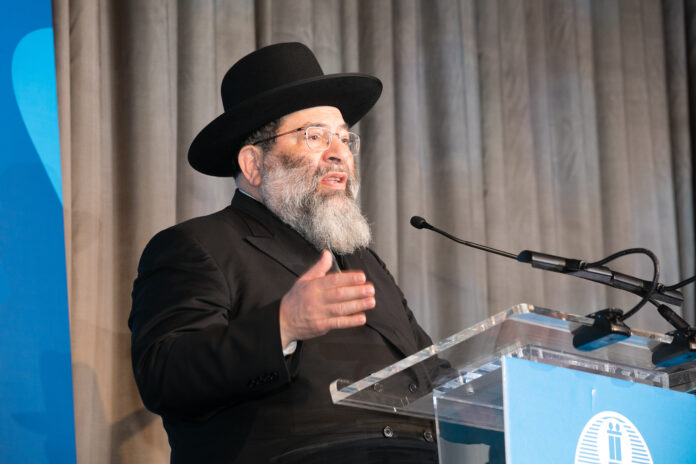
For all the photos go to https://matzav.com/photos-scenes-from-the-life-of-the-mattersdorfer-rov-rav-simcha-bunim-ehrenfeld-ztl/
All credit goes to matzav.com

Harav Aharon Feldman shlit”a demonstrated incredible composure and dignity Monday night during a public asifah in Beit Shemesh that addressed the issue of giyus. The asifa, organized by the Ezram U’maginam organization, drew a diverse and mixed crowd and was headlined by Harav Feldman alongside Rav Yehoshua Eichenstein, Rosh Yeshiva of Yad Aharon and a close talmid and confidant of Harav Aharon Leib Shteinman zt”l.
During the event, a man from a Mizrachi background began shouting harsh accusations at Harav Feldman, including calling him a liar. As tensions rose and members of the audience began yelling at the man in response, Harav Feldman intervened calmly and firmly.
Rather than allowing the situation to escalate, Harav Feldman instructed those around him not to become upset and emphasized that the man had a full right to express himself. His response defused the confrontation and underscored his respect for every individual, even amid sharp disagreement.


(YWN World Headquarters – NYC)
All credit goes to the YWN
| Magazine Feature | All credit goes to GEDALIA GUTTENTAG and the Mishpacha


Photos: Elchanan Kotler
For half a century, Rabbi Meyer May cultivated mega-donors on behalf of the premier organization dedicated to hunting Nazis and fighting anti-Semitism. And yet, as he reaches retirement and the firewall that kept the oldest hatred out of the American mainstream has collapsed, the arc of his personal journey has bent back toward his first love — Jewish outreach.
Imagine you’ve spent a half-century building an organization into a world-renowned institution that does breakthrough programming, receives funding from the US government, and has branches across the globe. Over the decades, you raise more than one billion dollars. You’re on first-name terms with top figures in industry, and gain access to decision-makers from Washington, D.C. to the Gulf.
Then, as you approach retirement, the world undergoes seismic changes to the extent that the future of your life’s work is not clear.
That’s the situation that Rabbi Meyer May, the outgoing executive director of the Simon Wiesenthal Center and Museums of Tolerance, finds himself in.
Over decades operating out of Los Angeles, he’s helped oversee the SWC’s emergence as a juggernaut, leading the field in hunting Nazi war criminals, Holocaust research and remembrance, combating anti-Semitism, tolerance education, and defending Israel.
And yet, in the post-October 7 world, conditions have changed dramatically. Anti-Semitism has surged to shocking levels. In a perversion of Holocaust memory, those same charges of genocide are leveled at the Jewish state. The firewall that kept the oldest hatred out of the American mainstream has been eviscerated.
As Rabbi May himself puts it, “People say to me, ‘You stayed 48 years at the Simon Wiesenthal Center, but what did you achieve? They still hate us!’”
That very ability to take stock of his own life in such a clear-eyed way is part of Rabbi Meyer May’s story. Mentor to a generation of community leaders, mega-strategist and fundraiser for everything from establishing organizations to yeshivahs, his impact derives from the fact that his influential work wasn’t that of a careerist.
It was driven by a sense of mission to act for the Jewish people — one that stemmed from early exposure to Torah commitment. Old-time Lakewood and then Rav Soloveitchik at Yeshiva University put their stamp on him before he hit the road of Jewish activism.
“Everyone thought that I would be a pulpit rabbi, but ultimately I spent years involved in kiruv in L.A. in the movement’s infancy,” says Rabbi May.
Now, the arc of his history has bent back toward his first love — outreach. Having joined Aish as executive vice president with a mandate to mentor a new generation of staff as the kiruv powerhouse sets itself ambitious global targets, he gestures toward the view of the Kosel below the organization’s Jerusalem headquarters.
“This is the future of the Jewish people,” he says, “so this is where I want to be.”
When most people saw recent reports that Argentina is unsealing its archives on the country’s history of sheltering leading Nazis, the news was a reminder of a disturbing post-Holocaust chapter that ultimately felt remote.
To Rabbi May, it brought back a career’s worth of memories of the long pursuit of aging Nazis. Although he wasn’t a Nazi hunter himself — no derring-do is part of the Meyer May bio — he played a leading role in enabling the search to go on.
“Argentina’s archives will confirm what we already know,” says Rabbi May. “That there was a ratline — an escape network that helped senior Nazis evade justice — and that the Red Cross was involved.”
The culpability of the Red Cross — which has never apologized for its role in aiding Nazis — is one of the many unfinished pieces of Holocaust business for Rabbi May.
It’s not just about history — it’s about their present inaction on anti-Semitism today, which is why, he says, “I wouldn’t give them a nickel.”
“They didn’t make a single visit to the hostages in Gaza. The Red Cross raises money for international disasters. They visit prisoners of conscience in jails. They’re good at transferring bodies, but where were they for 700 days?”
In the search for Nazis who evaded justice, perhaps the biggest name to get away is Josef Mengele.
The murderous SS physician evaded identification by the Americans after the war, sailed to South America under a false Red Cross passport, and slipped the Mossad net when the Israelis decided to focus on Eichmann’s capture.
By the time the Simon Wiesenthal Center was established in 1977, Mengele was two years short of dying near Sao Paolo, where he’d been living under a false name since 1971.
For years, Nazi hunter Simon Wiesenthal had been on the Auschwitz doctor’s trail to bring him to justice, after the role that Wiesenthal had played in leading to Adolf Eichmann’s location.
“Simon showed me how he identified SS men. One method was an internal SS phonebook that they had in World War II. When it came to Eichmann, there was another method: He discovered that Eichmann’s brother was a lookalike — he saw him at the funeral of the parents. That family resemblance played a part in the identification of Eichmann.”
While it seems that Wiesenthal tipped off the Mossad that Eichmann was the Buenos Aires man known as Ricardo Klement, his pursuit of Mengele was unsuccessful.
The Nazi hunter only caught up with his evil target once Mengele was dead.
“When they found him in a grave, the question was identification. Wiesenthal didn’t trust the Brazilians to do a proper autopsy. This was before DNA identification, so we hired three leading American forensic pathologists, flew them down, and they participated. Based on skeleton size, markings, and so on, we concluded that it was definitely him.”
Along the way there were other setbacks, along with successes. The SWC campaign to prevent the beatification of Pope Pius, under whose aegis the Vatican did little to prevent the Holocaust, proved a failure. But the center succeeded in lobbying the West German government to drop the statute of limitations that would have shielded aging Nazis.
“That’s why the person we thought was Ivan the Terrible could be prosecuted,” says Rabbi May of John Demjanjuk, the Ohio auto worker accused of murdering hundreds at Sobibor.
“When Demjanjuk was sent back to the United States after his conviction had been overturned by the Israeli Supreme Court, Simon Wiesenthal Center founder Rabbi Marvin Hier was on the morning shows and said, ‘He may not have been Ivan the Terrible, but he was certainly a terrible Ivan.’”
Along the way, Rabbi May developed a close relationship with Wiesenthal himself. “We helped make him an icon,” he says. “Early in his career he couldn’t raise money. He once came to L.A. and got five-hundred dollars for his entire effort. We came on board, and I followed his speakers’ bureau schedule — wherever he spoke, I’d go and set up a parlor meeting the next night. I always took him from the hotel to our events.”
Typical of the care for people that typifies Rabbi May, he saw beyond the driven Nazi hunter to the man underneath.
“Once I saw that he wasn’t well. My brother-in-law is a top ophthalmologist, so I took Simon to him. Later Simon asked me to visit him in Vienna. He wanted to show me all his medals, all his accolades — he wanted someone he felt cared about him to see it.
“He was a tough man, but when he softened up, he was a wonderful person.”
What began as Simon Wiesenthal’s personal crusade to hunt Nazis, says Rabbi May, morphed into something broader: a push to perpetuate the memory of the Holocaust victims and the events themselves.
“He began as a Nazi hunter and ended as an educator. Justice, not vengeance, he would say — a phrase that became the title of a book that he wrote.
“He would tell survivors, ‘When we meet the victims in the next world, you’ll say you became a doctor, a lawyer. I will say: I never forgot you.’”
The Wiesenthal Center and the man whose name it bore weren’t always in alignment. They disagreed deeply over the Kurt Waldheim case.
Waldheim was a UN Secretary General in the mid-1980s when he was exposed as a Nazi-era intelligence officer involved in atrocities in the Balkans, including the transfer of Jews to the SS.
Waldheim’s exposure brought intense media scrutiny during his 1986 Austrian presidential bid, which he narrowly won, and global ostracization during his subsequent term. The SWC campaigned against Waldheim’s admission into the United States, but Wiesenthal disagreed.
“He said you can’t call someone a war criminal without due process. We said due process or not, he should never be president of a country or head of the UN. Simon wasn’t defending him. Later, when Waldheim walked into a room where Simon was speaking, Simon stepped off the stage. He simply believed that integrity of historical truth requires pristine proof.”
That drive for historical accuracy was at the heart of the SWC’s mandate, says Rabbi May.
“We saw ourselves as repositories of memory. Everything had to be bulletproof — no gray areas.”
For decades, Holocaust memory was the single greatest force that kept anti-Semitism on the fringes of American public life. It was enough to blacklist Waldheim, and to compel a reckoning with Holocaust era complicity in a host of Western countries.
The Wiesenthal Center itself became a prominent part of the Holocaust education architecture. For nearly five decades the center served as a one-stop shop to counteract Holocaust deniers, prevent distortion of history, and support Israel. From 1993, more than three million students passed through the Center’s Museum of Tolerance in Los Angeles to learn about racism with a focus on the Holocaust.
But along the way, Rabbi May would encounter a creeping universalization of the Holocaust.
“There’s always watering down. People create moral equivalencies where they don’t belong. Cambodia is horrible, but it’s not Auschwitz.
“Once I told a group of African-American educators: Sitting in the back of the bus is appalling, but it is not Auschwitz. Auschwitz stands alone.”
The passing years didn’t do the cause of Holocaust education any favors, and neither did the declining number of survivors. But it was October 7 that showed the model to be broken.
“We were among the loudest voices speaking out about anti-Semitism after October 7,” says Rabbi May. “It was a massacre, a world story. But that the murder of defenseless Jewish women and babies should have had the worst reaction — that it triggers more anti-Semitism — defies logic.
“The only way to explain it is the halachah that “Eisav sonei es Yaakov.”
The Holocaust still profoundly affects those who see the museum, says Rabbi May, but it’s clear that Holocaust inversion — in which Jews are accused of the very same crimes that they suffered — has taken over.
Part of the problem, says Rabbi May, is the fragmentation of the media landscape. It’s not just the rise of Holocaust denial — it’s also the fall of TV and the rise of internet influencers.
“In the old days, there were ten TV trucks parked outside our building, and Rabbi Hier’s three sentences determined the Jewish world’s message. Today the battle is influencers. We need influencers influencing for us.”
That now-hostile landscape — and the fading relevance of Holocaust education as a buffer against anti-Semitism — begs a big question about Rabbi May’s career. Was it the right approach? Were the mega-bucks poured into education worth it?
It’s far from the first time in recent years that he’s been asked this pointed question. In his polished yet candid way, Rabbi May answers with a parable from the world of sports.
“A rabbi sits down to watch a hockey game, and his team scores. One fan says, ‘Rabbi, you’re fantastic.’ The other team scores, and so the fan says, ‘Rabbi, what good are you?’
“The rabbi turns to the man and says, ‘Ed, we’re keeping it close. Imagine if I wouldn’t have been here — it would have been worse.’”
The parallel is that in the long arc of history, decades of post-war quiet were partly a product of education.
“History has previous examples of a goldene medineh that turned, such as Poland. History turns.
“We’ve hostedmillions of kids at the Museum of Tolerance since 1993. Does that mean that none will join anti-Israel college rallies later? I don’t know. But we did the right thing — without it, things could have been worse.”
That faith-filled view of Jewish history is what has defined Rabbi May’s period in the upper reaches of the Jewish philanthropy pyramid. He’s ultimately a product of a yeshivah who spent decades in a world of influence, yet retains the sense of mission and identity that he entered with.
His story began very far from the moneyed environs of Los Angeles, in the world of old-time Lakewood, New Jersey. Born in 1952 in New York, he was nine when his family moved to Lakewood in 1961, where he lived until his marriage 11 years later. Meyer’s father was a rocket scientist who struggled for employment due to his Shabbos observance, and his mother was secretary of Sons of Israel, the shul that still stands on Lakewood’s Madison Avenue in silent testimony to a Jewish life in the town that predated the famous yeshivah.
“The rabbi of the shul was Rabbi Pesach (Paul Z.) Levovitz — a big talmid chacham and nephew of Rav Moshe Feinstein. Since my father had to leave on a five a.m. bus to New York each day, he would fall asleep when the rabbi started speaking on Shabbos morning, but he would also learn with him.
“I grew up wanting to be Rabbi Levovitz, and it was widely assumed that I would be a pulpit rabbi.”
The shul rabbi wasn’t the only role model. In those days of a small yeshivah and small local Orthodox community, there was a natural connection between the two populations — a connection facilitated by none other than Mrs. May.
“My father didn’t go to yeshivah as a child because it was the depression years and his parents didn’t have any money, so my father never learned how to learn. So, my mother says, hey, we’re living in Lakewood and there all these tremendous talmidei chachamim around, and you don’t attach yourself to any of them.
“So she started the forerunner of what’s now Partners in Torah, by putting the balabatim from Congregation Sons of Israel in touch with various people to learn.”
Young Meyer May went to Lakewood Hebrew Day School with some of the future big names of the American yeshivah world.
“I’m technically royalty of Lakewood,” he says. “At my wedding — ten years after Rav Aharon Kotler was niftar — his rebbetzin insisted on coming.”
One figure who made an impact on him in those early days was Lakewood rosh yeshivah Rav Yisroel Neuman, known as a tremendous masmid.
“Whenever I’m asked who is the most impressive person that I’ve met, I always surprise people. They expect me to name a king or a president. But Rav Yisroel Neuman of Lakewood is my hero.
“Growing up in Lakewood, every free hour I went to the yeshivah. I never came without seeing him there, walking and learning. I couldn’t understand how he always happened to be there, until at age fourteen, I realized that he always happened to be learning when I came, because he was always learning. That made a lifelong impression.”
Rabbi May would go on to develop a family connection that bridged the worlds of Lakewood and Yeshiva University, where he ultimately headed. “My father-in-law, Rav Yitzchok Filler — who gave the chazarah shiur for Rav Moshe Soloveitchik at YU — was known as the illui of Kletzk. He was Rav Aharon’s talmid muvhak.”
Those roots in Lakewood have given Rabbi May the ability to be comfortable in multiple parallel worlds. .
It’s meant that he has children living in Lakewood today, and that he’s a premier address for yeshivos wanting advice on fundraising campaigns.
That background also meant that Rabbi May periodically consulted gedolim on big decisions.
“Every ten years I went to a gadol who didn’t know me to ask if I was on the right track. Why someone who didn’t know me? Because people who know you tell you what you want to hear.”
And the early examples of greatness that he witnessed in Lakewood mean that he never gave up his own learning commitments despite the time away from the beis medrash.
“I learn three blatt of Gemara a day. I’m in three cycles of Shas at the same time — two Bavli and one Yerushalmi.
“The only way I keep track is writing down what daf I’m on in each cycle.”
If Lakewood is the subtext to Rabbi Meyer May’s story, the headline was written in the Yeshiva University world. In 1978, he headed to Rav Soloveitchik’s shiur where he quickly discovered that he was out of his depth.
The fact that he’d been considered bright in high school was scant comfort when he realized that the famous lamdan’s shiur was really tough going.
“I was petrified he’d call on me. He was very direct and not forgiving. He’d go through his book and land on me: ‘Meyer May, what’s the question?’ No matter what you said, it wasn’t going to be enough. He would say, ‘For that you’re in my shiur? Can anybody just get into the shiur?’”
Savvy students in Rav Soloveitchik’s class developed a stratagem to avoid these encounters: For the first three days of the semester, they arrived a half-hour late. If you weren’t there for the first three days, Rav Soloveitchik crossed you off the list — then they could attend without getting called on.
“The shiur was packed — 70 men. I was valedictorian everywhere I had ever been, the smartest everywhere, until I got to YU. Suddenly I was average or below. Everyone was smarter than me. But it was exhilarating. You were watching brilliance and emes develop in front of you.”
Fascination with Rav Soloveitchik’s Torah combined with the difficulty of approaching it were ultimately what led Rabbi May out west.
“I wanted to learn the Rav’s Torah but was afraid in that shiur. Rav Moshe Meiselman, the Rav’s nephew, was starting the YU kollel in Los Angeles, and learning with him gave me access to the Torah — not firsthand, but a very good secondhand. For me, it was the perfect opportunity.”
Moving to Los Angeles brought a young Meyer May into contact with the man who would open up horizons in different worlds — Wiesenthal Center founder Rabbi Marvin Hier.
“I came to L.A. because I wanted to learn in the kollel and needed more time. Rabbi Marvin Hier, the founder of YULA (Yeshiva University High School of Los Angeles) and later the Wiesenthal Center, required all of us to do communal service at night. You learned full-time morning and afternoon, and at night you had to give something back to the community.”
For Rabbi May, that something rapidly developed into a kiruv career.
“Rabbi Hier asked me to start a program for adult education for unaffiliated Jews. I made a brochure — I didn’t know the first thing about making a brochure. At the beginning I had two women in my class. After six weeks I said I wouldn’t continue. They said, ‘Rabbi, one day we won’t be able to help our children with their homework — can you do six more weeks?’”
A short while later, Rabbi May had 50 people in his class, his wife Rebbetzin Shulamit had another 50 in hers, and Rav Meiselman had 50 in his. By four years later, the program had 600 people learning every week.
The learning programs led to shabbatons three times a year. People brought sleeping bags and slept all over the YULA building. Friday night there was a speaker, Shabbos day another.
Gone were the dreams of a pulpit position; instead, the Mays were on the front lines, teaching Torah.
Those were heady days, with many successes. One memorable breakthrough was a woman whose mother was a fervent Conservative Jew, who rebelled by joining the American Nazi party, then rebelled again and became Orthodox.
She came to the Mays for Shabbos for a year and a half. Along the way, Rabbi May found himself in the odd position of walking to shul in Beverly Hills with a woman wearing a tallis and yarmulke.
Every Shabbos, that would be followed by two and a half hours of questions of life and Judaism. These were exhausting encounters, but ultimately fruitful. Eventually, the woman went to Neve Yerushalayim, then Gateshead, and married an avreich in the Mir.
“The message,” says Rabbi May of that colorful search, “is that everybody is able to come back. Everyone’s looking for truth. You need patience — and you need a wife who goes along with it.”
Like many mekarevim before and since, parnassah was a factor in the decision to move on. In Rabbi May’s case, there was also a process of transition under Rabbi Hier’s leadership.
“Rabbi Hier asked me to help him with money for the institution. At first, I raised money for YULA, but it was only five hundred dollars at a time in donations. He produced a film on the Holocaust that won an Academy Award. I suggested we take the film on the road — make a premiere in each community. Half the money would go to YULA, half to the Wiesenthal Center.
“We made $200,000 at a premiere — that’s a lot of $500 donations. Then Rabbi Hier said, ‘You’re next to me.’”
It was an inspired choice, because Rabbi May was indeed blessed with the rare ability to connect to people and raise money — lots of it.
Over the years as executive director of the Simon Wiesenthal Center, he brought in $1.6 billion — including $325 million from governmental agencies.
There’s nothing that opens doors like money and connections, and the two rabbis at the head of the SWC found themselves acting as roving diplomats for the Jewish people. Rabbi Hier sat at seat 7a, and Rabbi May was 7b as they crisscrossed the globe on behalf of Israel and the battle against anti-Semitism. The pair’s visit to Dubai and the UAE in 2017 served as a trial balloon for what later became the Abraham Accords.
Influence and access are self-reinforcing – and with a massive global following and the ability to orchestrate large grassroots lobbying campaigns, the Simon Wiesenthal Center became too large for hostile politicians to ignore.
But in terms of fundraising, the secret to Rabbi May’s ability to open doors proved to be integrity: He is a man of his word — a quality that inspires others to trust him with their hard-earned money. “Before the art of fundraising, you have to be a statesman,” Rabbi May says. “People give to people, and they have to respect you. You have to be a person that people see as representing something noble.”
Allied with that was the genuine respect that he had for others — especially those acting as a mensch — whatever stage of religious observance they were up to. Asked who he found inspiring in the wider world, Rabbi May mentions Lester Crown, billionaire head of defense giant General Dynamics.
“I took Simon Wiesenthal to visit him, and he insisted on walking Simon right through the company offices to the elevator. I thought that that was an act of class, that you’re a Lester Crown, but you met your match, and you have to show him the dignity that he deserves.”
A lesson in the meaning of words came via board chairman Larry Mizel, whose son had become religious. The philanthropist had a request: “I want you to look after my son,” he said.
“I’ll try my best,” replied Rabbi May — fully meaning it, as he went on to host the son extensively.
But Mizel wasn’t happy with the response. “You’re going to try?” he said. “When you ask me for a million dollars, you want me to say I’m going to try to give it? If you spend the next five years with me, I’ll never say the word try.”
“He was right,” concludes Rabbi May. “Try is an equivocation. It’s just the wrong word — there’s no integrity in it. So, I erased the word from my vocabulary.”
That openness to both people and new angles meant that the five decades in Los Angeles saw Rabbi May reach the pinnacle of Jewish organizational life. It’s been a long roundtrip, but as he heads to the next chapter in his own story, Rabbi Meyer May has, perhaps unexpectedly, come full circle. What began with outreach on the West Coast is culminating in outreach at the Western Wall.
And fittingly, given the amount of time he’s spent mentoring others, it’s one of those protegées who has opened that door.
Aish CEO Rabbi Steven Burg was a beneficiary of Rabbi May’s guidance back in Los Angeles. Working as West Coast director for NCSY, Rabbi Burg was invited to join a Simon Wiesenthal Center mission to Washington, D.C. in the course of which he met Rabbi May.
“From that trip forward, he became my mentor,” says Rabbi Burg. “During my five years in Los Angeles, he became my teacher, my advisor, and my example of what a true leader looks like. I would go to him with every question I had about running an organization. No matter how busy he was, whenever I called, he always made time for me, because he is a Klal Yisrael person foremost.”
Two years ago, when it became clear that the founding generation at the SWC were preparing to retire, Rabbi Burg made his move, turning to his old mentor with an offer that he couldn’t refuse.
“Why don’t you wrap up your career by building a makom Torah in Yerushalayim?” he proposed.
What Rabbi Burg had in mind was no sinecure — to dispense wisdom while dwelling on former glories in retirement.
Aish is drawing up ambitious plans to reach every last unaffiliated Jew through digital Torah learning in a world of post-October 7 dislocation. A standout initiative is AishU, a program that will give students college credits for Jewish studies. That formalizes long-term trends in outreach in which students undertake Torah learning in exchange for various incentives – an approach that Aish’s previous iteration pioneered.
It also aims to address the sense of isolation felt by a generation of young Jews studying on often-hostile campuses.
In short, there’s now space for an aggressive push to break boundaries in the outreach world – and the approach to Rabbi May is part of that big thinking. So he’s on board fora series of ambitious new global projects, at a time when most people are settling in for some quiet nachas from the grandchildren.
After a lifetime of achievement on the big stage of L.A. and the world, for Rabbi Meyer May, it’s full speed ahead on the next project — the future of the Jewish people.
“I enjoyed what I did — but there’s more to life than meeting popes and princes and kings,” says Rabbi May. “And if there’s one thing I’ve learned along the way, it’s that if you’re given the skills to do impactful things, you have to rise to the challenge.”
(Originally featured in Mishpacha, Issue 1090)
| Magazine Feature |

For 25 years, Rabbi Moishe Indig’s door has been a mandatory destination for anyone seeking public office in New York. The legendary political strategist and leader of the Satmar kehillos of Williamsburg and Boro Park leverages a bloc of thousands of votes, and candidates on every level learn early that they would be wise to win him over to their side.
Indig insists he never wanted anything to do with askanus — he was drafted into the role by legendary Satmar rosh hakahal Rabbi Yitzchok Rosenberg and tried numerous times to get out of it.
“This isn’t for me,” he would complain to Rabbi Rosenberg. “Choose someone else. I want out.”
“You can’t,” Rabbi Rosenberg often answered, “Not in this gilgul. It’s in your blood. Even if you had a transfusion, it won’t leave.”
Indig is the founder and leader of the Williamsburg Jewish Community Council, which responds to about 80 requests per day for help with various complex issues, from political flexing to government services and even immigration.
The reluctant leader has frequently played the role of political kingmaker, swaying more votes in an election than the margin of difference between winners and losers. His valuable endorsement can be the easiest thing to gain for some, but impossibly difficult for others. It has also proved surprising again and again, as he has stood loyally and unflinchingly by some candidates unpopular within the community — and without.
Perhaps his most shocking endorsement came several weeks ago, when he backed socialist candidate Zohran Mamdani for mayor despite his widespread reputation for virulent anti-Semitism — to the shock, consternation, and condemnation of layers of leaders, laymen, and powerbrokers.
Why did he do it? What did he get in exchange? And what’s next on his list of political alliances? We sat down with Rabbi Indig to get a sense of how he operates.
My number-one rule is never to tell someone, “It’s not my problem.” When I was young and newly married, I had trouble with an insurance technicality. I asked a person in a position of power for help, and he said, “This is your problem, not mine. I don’t have time to help you, what do you want from me?”
Since that moment — as I tell all my staff, paid and volunteer, at the JCC or other places — I made it a rule never to tell a caller “We don’t deal with this.” We may not deal with it directly, but there is always some way we can help. There are connections, people, someone in the Rolodex, chavrach chavra isa lei — we know a guy who knows a guy — there some way we can guide them, no matter what it is. That’s the definition of askanus and that is what it’s all about.
That’s just as a tool to help people in the community with their needs. Many candidates ask, “What do you want from me?” I always tell them that I don’t want anything — just an open-door policy. We have a large community, a lot of people with a lot of issues. Often, it’s only the person on top — the elected official — who has the power or willingness to help. All we want is for them to be a friend, ready to listen, and help when we need it, if possible.
It’s easy for government employees to say no, because “yes” means they have to work harder for the same paycheck. We can take “no” for an answer as long as it’s for a good reason, but not just based on laziness. Sometimes having someone on top involved can turn it into a “yes.”
There’s never just one issue or factor to consider; you have to take the whole picture into account. Generally speaking, our priorities work as follows:
For example, when Bill de Blasio was running in the NYC mayoral primary, another candidate demanded our support. I said, “You’re right, you are a friend, you helped us. But you’re at two percent. I can’t get you from two percent to 50 percent.” DeBlasio was not the front-runner, but with our endorsement, he was able to get over the top and win. People called me crazy for supporting him. But in the end he won by just a few thousand votes; our support made the difference, and he was indebted to us. The same occurred with Eric Adams.
All the time! I’ve been working with open, unabashed anti-Semites since the beginning. My approach is always that you catch more flies with honey. Don’t fight! I’m a Satmarer, and the Satmar shitah, taught to us by the Divrei Yoel, was always lo l’hisgaros b’umos, never antagonize the nations. It doesn’t make a difference what religion they observe — Christian, Muslim or whatever, do not fight. We’re in galus. We are grateful to have the privilege, baruch Hashem, in this malchus shel chesed, to have a say, to vote, to endorse or support whomever we feel would be best for us. But we do not use it as a weapon, do not go to war with anybody. That’s a big no-no.
The first anti-Semite in history was Eisav. And what did Yaakov do? He gave him piles of gifts. Ja, mein Herr. Yeah, I’m your slave, how are you? What else can I do for you? He hugged and kissed him even while Eisav was trying to bite him.
With this approach, we’ve won over many people.
For example, Brooklyn Borough President Antonio Reynoso was considered for years to be an outright enemy of our community, but now he’s a great friend. The same is true for Ed Day in Monsey, and many others.
You can even win people over who think they don’t need your vote. Emily Gallagher, state assemblywoman representing Williamsburg, told us blatantly, “I don’t need you. I don’t need your endorsement. I don’t need your support. I need nothing from your community. I’ll win without you and I want to have nothing to do with you.” Okay, we weren’t going to support her anyway, she was primarying Joe Lentol, an old friend. Joe was polling in the single digits, but our endorsement got a big turnout for him and he lost by just a few points. The night of the election, after seeing our loyalty and hakaras hatov, Gallagher was singing a different tune, calling and asking for a meeting to discuss collaboration. She subsequently developed into an invaluable asset for the community.
It started with a Jewish staffer, former chief of staff for our state assemblywoman Emily Gallagher. He had been very helpful to the community with Gallagher, and then went to work for Mamdani. He reached out to us several months before the primary, asking for a meeting. Mamdani was a back-of-the-pack candidate at the time, but our policy is that we meet with almost anyone who requests it. He came to visit us at the JCC.
I said to him, “The perception is that you are an anti-Semite. So I want to ask you straight out, are you an anti-Semite?”
He said, “No, I’m not an anti-Semite. I just don’t like what Israel is doing in Gaza.”
“Do you like what Russia is doing in Ukraine?” I countered.
“No, of course not,” he said.
“So how come no one hears about that?” I pressed him. “Is it that as a Muslim, the mistreatment of Muslims concerns you more than others?”
He explained that as an American, his activism is driven by the use of US taxpayer dollars to aid the war in Gaza. Russian aggression against Ukraine is not subsidized by the United States.
To us, that’s an untenable double standard, but I wasn’t looking to win a debate with him on foreign policy; I was looking for indications that in his mind — however much I disagree — it made sense to condemn Israel and still work with me.
“I promise you,” he continued, “I want to be your mayor, I want to be your friend, I want to work with your community and make sure your community will be happy with me, satisfied with me, and I promise they will like me. I’m here to work; I want to be everybody’s mayor.”
We talked about the issues affecting our community in New York City — education, public safety, housing, et cetera. It was like a good first date.
He didn’t have anything to gain by convincing me that he was not an anti-Semite, and neither did I. He was going to win without a single vote from our community — he knew it and so did I. And I told him the story of Tony Cellini (see sidebar), making the point that I could work with him, even if he was a rabid anti-Semite. “But I’m not,” he said. “You won’t need to win me over, I’m already here.” At later meetings, he would refer back to that story and say, “You don’t need to work on me… I’ll prove the entire community wrong.”
I’ve been doing this for twenty-five years, and I know there was really no reason for him to pursue a relationship with us unless he meant it… but he did so, repeatedly working diligently to build a rapport.
Again, I’m not here to defend any of his objectionable positions or public statements. I’m here to establish the access to the halls of power so critically needed by our many communities. This was the time and address at which to do it — not after the election, coming like an esrog after Succos.
I’m not his spokesman, but my personal opinion is that he’s still young and fresh, just starting his actual career in public service, and he’s going to make some mistakes. He is a pretty smart man and will learn quickly what to say, how to say it, and mostly what not to say. People are going to focus on every little mistake he makes, much as the left does with Trump. The real problem at that demonstration was the weak police response, which he doesn’t have any control over until January 1st. Commissioner Tisch has apologized for that.
Once you get into this position you learn very quickly that there are many people and communities you have to deal and work with in New York City, the biggest and most diverse city in the world. You have to get out of your own little box. You can see he is already making adjustments — he said a few weeks ago he will not work with Trump, but even before he took office he had a great meeting and is already working with the president.
Not any more than any other politician in New York, no more than Cuomo or anyone else. The truth is that it is irrelevant. I only need to be able to work with people, I don’t have to trust them. I’ve been able to work with many officials who were much more anti-Semitic than the worst accusations against Mamdani, and I am secure in the decision that I can work with him. Getting guarantees from him before the election gives me critical leverage afterward — if he fails to be a friend, I can call him on his promise to be there for us. His voting record in the Assembly also benefited our community.
I was the first to endorse Antonio Reynoso, and everyone attacked me for it. But I knew I could work with him, and he became a great partner. I took him to other communities, to meet other Jewish groups, and he said, “Rabbi, I don’t get it, I don’t recognize these people… they used to hate me, now they just want to be my friend.” I told him, “You’re going to be their friend, too.”
During his most recent reelection campaign, every single Jewish group endorsed him.
I’m don’t involve myself in foreign affairs and international politics. I’m only interested locally, here in New York, in what is in the best interest of our community now. I didn’t take Israeli politics into account at all.
Bibi knows how to run his own show. He does not need my help. He doesn’t need to worry about our community in Brooklyn and I don’t need to worry about him. Let him let him do his business and I’ll take care of ours. Our best interest dictates that we have to have an open relationship with the mayor, not fight him; and this candidate had a good chance of becoming mayor.
Activists called me from all over, people that never spoke to me before, demanding that I not support Mamdani. I asked them, what do you suggest I do the day after the election? What’s the plan for Wednesday?
They told me, “Move to Israel.”
I said, “Look, that’s a great solution for you — you can move. I’m not moving and I’ve spoken to a few people who are also going to stay. You can go, but I have to take care of the people that are planning to be here, and that means having a relationship with the man who is likely to be mayor.”
Mamdani knows, and I know, and you know, that he cannot arrest Bibi. It’s not even relevant.
The Divrei Yoel himself taught us that. Despite his shitos on the Zionist State, he refused to have anything to do with a politician that was anti-Israel. He would say, “His anti-Zionism is not because he learned V’Yoel Moshe; he’s anti-Israel because he’s an anti-Semite.”
That applies to an American politician from Kentucky or New York who has no reason to be anti-Israel, and if he’s busy bashing Israel, it’s because he hates Jews. But if someone is a Muslim and says, “I’m not an anti-Semite, I’m against the Israeli government because of how my Muslim brothers are suffering at their hands,” that can actually make more sense. To us, that’s unacceptable sympathy for terrorists and murderers, perversion of truth and justice. But his personal ties could at least justify a perspective that bifurcates Israel and the Jews of New York.
Most of the response inspired by his rhetoric is confined to anti-Semitic symbolism, chanting, and rallying coming from people who don’t even know what they are cheering about. They’re just looking for action and reaction. If we stop making a big deal out of it, many of them will lose interest and move on. It’s our own obsession over swastikas on the wall that keeps them coming back. Of course, actual violence or intimidation needs to be denounced and condemned immediately, so that haters see they won’t get away with it, or become bolder. Mamdani has committed to do so — as he indeed did even before the election. Seven years ago, long before he dreamed of running for mayor, he denounced anti-Semitism in a public speech available online.
When we first met, I told him I couldn’t endorse him as long as Eric Adams was in the race, because we are loyal to our friends. He accepted that and said he would be back to discuss it when Adams dropped out.
He did come back several times for follow-ups, showing a lot of interest and desire to work together.
The other option was Cuomo, whom I did endorse in the primary. I had a good relationship with him, but we fought him very hard during Covid. I don’t have to tell you how much everyone hated Cuomo until they got scared of Mamdani. Cuomo himself told me, “I’m not stupid. I know everyone hates me, but you have no choice — you have to vote for me because you are afraid of Mamdani.”
There was an event for him in Williamsburg, and people begged me to come. In line with lo l’hisgaros b’amim, I came. But I told him, “Mr. Governor, you know people in Boro Park are very upset with you over what you did during Covid. Why don’t you just apologize? If you want the community to be with you, you have to show that at least you’re asking for it.”
He said, “Nothing to apologize for. And I have the nomination in my pocket already.”
I told him he didn’t have it, but he wasn’t interested. He didn’t even want to come to the meeting of the coalition of yeshivos and kehillos in Boro Park to ask for the endorsement — that’s why they gave it to Adrienne Adams.
We did endorse him in the primary, and from the day we did so, he went MIA. He didn’t answer a phone call, didn’t respond to a text; not to me, not to anybody. He went completely back to being Mr. Cuomo, and he hadn’t even won the election yet. If this is how he treated people once he got the endorsement and before he was even elected, what would he be like as mayor?
With all due respect, he had his chance. We saw what he’s like, and he didn’t quite pass the test. Mamdani, on the other hand kept calling and coming back, running after us, promising to be there for us after he wins.
Politicians always come visit askanim in the succah, that has been a traditional step for 50 or 60 years, in every neighborhood and community. They’ve all come, just as they go to the Chinese New Year or to Ramadan. It’s meant to be a sign of respect to the community. Mamdani’s people reached out and asked to come to the succah, so we arranged a meeting in the succah of Rav Landau of Ribnitz. He made a great impression on everyone there. He was eager to go to more, to anyone who would have him.
In the meantime, Cuomo, who was supposed to be the favorite of the Jews, didn’t ask to go to any succah. Not one.
There was a lot of pushback on bringing him into the succah, but it’s nonsense, part of the propaganda campaign against him. I can show you pictures of every politician in the succah.
After Eric Adams dropped out, Mamdani came back to ask for my endorsement. I didn’t promise him votes. I explained that because the community was so convinced of his anti-Semitism, I wouldn’t be able to get the majority of people to vote for him. The super PACs spent millions and millions convincing people that he was Hitler, and that all the Jews were going to be killed the day he gets into power. It’s a tough sell to people to vote for someone they think is going to kill them the next day. We did get people to vote for him, but not the usual numbers.
I offered to help his election in better ways. I said I would endorse Sliwa, or even Eric Adams (who was still technically on the ballot) to pull votes away from Cuomo.
But he refused. “I don’t need your votes,” he said. “I have the votes. I’ll win anyway, with you or without you, but I want to win with you. I just want your endorsement because I want to prove that I’m not an anti-Semite. That’s all I ask for.” I saw that as a beautiful invitation to our community.
We talked about taxes, housing, education, public safety, and more. I didn’t ask for specific guarantees, but he promised an open door for anything we need; a seat at the table and representation for issues that concern our community. He was receptive to our concerns about chinuch, relating it to religious education that is important to his own religious community. As an assemblyman, he voted for an education bill we wanted. On public safety, he vowed to retain Police Commissioner Jessica Tisch.
Rabbi Hoffman and I were the only two Jews invited to his victory party, and among just a handful of people invited backstage from the 3,000 attendees. He greeted us, promised he would not forget, and that we had access at all times.
I never do anything without asking the Rebbe. He’s not usually directly involved in politics or endorsements; he has people for that. I present him with the facts as I see them, and he makes the decision. He doesn’t necessarily rely on my report.
When I wanted to endorse Kathy Hochul, people were screaming at me that she was going to ruin yeshivos. Since it involved chinuch, the Rebbe wanted to speak to Hochul himself. They had a long meeting, after which he approved.
This time as well, I presented all the facts as they were, what’s being said, what’s being alleged, what the options are, and he said, “Go ahead.”
Interestingly, people complain about Mamdani’s plan to freeze the rent in stabilized apartments, but the Satmar Rebbe is doing exactly that in Kiryas Yoel — he has capped the rent that people can charge and actually driven down rent and sale prices on homes in the town. I see young families in Williamsburg choking under impossible rents; I understand the need to get it under control in New York City.
I’m taking missiles over this, not just bullets. Millionaires and billionaires I’ve never heard of keep calling me and telling me I can’t do this, because Mamdani’s an anti-Semite. If he turns out to be an anti-Semite, who is going to have to deal with him? Me! Not them! They accuse me of having an agenda. I think they have an agenda. I’m working for Klal Yisrael for 25 years, while they are making money off Klal Yisrael. Why do they feel entitled to tell me what’s good for Klal Yisrael now? Where have they been all this time?
Rich developers called me to complain that Mamdani is going to ruin their business. Oddly, they’re more responsible for his election than I am. For years, major builders — a large percentage of them Jewish — have been constructing high-rise luxury apartment buildings in Williamsburg, Greenpoint, Park Slope, and many similar areas. Families are priced out of these developments, and they are populated with hundreds of thousands of young, single, liberal hipsters — Mamdani voters.
People call me a kapo. Anyone who knows what a kapo is can see that I am the exact opposite — a kapo beat you up to save himself. I’m taking beatings to save you.
Some people stab me in the back in public, and privately apologize and ask for a favor in the same breath. I don’t turn them down, I don’t hold a grudge. I’ve been blessed with skin thick as a turkey.
To be a real and responsible leader, you need to make correct decisions that are in the best interest of the community, even when they are difficult and unpopular.
But people are already telling us we were right, that it was chacham haroeh es hanolad. We are currently the only Yidden with access to the future City Hall, but I hope that changes.
You can’t imagine how many new friends I’ve made since the election.
My Rebbe taught me to always be cognizant that we are guests in this land. It’s not our business to tell the goyim how to behave. We are in galus, we are guests here. The Divrei Yoel taught that we should be grateful that we are allowed to live in peace and even vote. Our grandparents hid in their homes on December 25 — for 2,000 years, there was never a place like this for Klal Yisrael. We need to thank Hashem that we live in the best of times relative to galus. We are not entitled to dictate morals to our hosts.
We are willing to work with anyone, but as I said earlier, they have to have a realistic chance of winning. As of now, Republicans in New York do not; I can’t vote them in, so we need to learn to work with Democrats.
As an aside, not a single Republican in the state voted on our behalf for education. Not one.
We are looking out for the good of the community. One of the rich people who called to yell at me for endorsing Mamdani said it “makes the Satmar vote appear to be transactional.” I said, “You’re making a mistake. It doesn’t appear transactional, it is transactional.”
What do you think politics is? You think I’m his mechutan? I’m his brother? That I love him? This is absolutely transactional.
He wants to be mayor, and I want to make sure that when he is mayor, he’s going to work with our community. And several years from now when he’s out, the same will be true for the next one. This is not personal, it’s transactional. We are loyal to our friends, and will support anyone who is loyal to us and will be receptive when we have issues.
That was before my time.
It’s too early to tell what will happen in that race. If all things remain the same, and nothing crazy happens, as of now, we most likely will. She kept the promise we asked of her with regard to education, she helped with water supply in KJ, and has worked well with us. She’s an incumbent with a good relationship. We would need to meet with the board and the Rebbe, but all things being equal, we likely will endorse her.
Mamdani is ready to talk with whoever wants to reach out to him. He is eager to prove that he is a friend. He promises that within three months of his inauguration, everyone will see it and tell me I was right. Time will tell. If he keeps his word — which I hope and believe he will — we should just be grateful to Hashem.
Here’s a prediction: I won’t be surprised if, within a year or two, we see Mamdani take a trip to Israel.
W
hen Kiryas V’Yoel Moshe — Satmar Bungalows — opened in Sullivan County more than 20 years ago, the Thompson town supervisor was an unabashed, raging anti-Semite named Tony Cellini. As chief executive of the municipality, he had full control over most important town functions, and made no secret of his intent to block Jews at every turn. Cellini explicitly declared his contempt of Jews numerous times, and flexed every form of interference he could — preventing applications to open a grocery or even denying permits for minor repairs.
A group of leading askanim gathered to strategize removing Cellini from office. At the meeting, a young Moishe Indig asserted that political opposition was the wrong approach. “It’s impossible to get rid of him, he’s too well-liked in town,” he told the others. “The only solution is to work on winning him over.”
Indig was laughed out of the room — the idea was as farfetched as convincing Yahya Sinwar to open a kollel.
Indig took matters into his own hands.
He went to the municipal building to try to talk to Cellini, and stood in the doorway of his office like Esther Hamalkah waiting to be noticed. When Cellini looked up, he began screaming and cursing at the young chassid, shouting about who let the Jew in. He personally threw the visitor out of the entire complex, shouting obscenities all the way.
Undeterred, a few days later, Indig waited for Cellini in the parking lot and tracked him to Walmart, where he schemed a “chance” encounter in an aisle.
The town supervisor didn’t recognize the Jew he had recently kicked out of his office, and Indig launched into his spiel without hesitation. “Hey, aren’t you Tony Cellini, the Tony Cellini, town supervisor?” he said, with obvious excitement. “So nice to see you here… the Jewish community here owes you such a big thank-you!”
Caught off guard, Cellini asked, “What do you mean?”
“Well,” Indig plowed ahead, “it’s all thanks to you that we can enjoy summers with our families in this beautiful environment. You work so hard to keep the town nice and pleasant. All the surrounding towns are slummy dumps, but this one is gorgeous. Thank you! And you recruited Walmart to come here, which is so helpful….”
Who doesn’t warm up to a little flattery? Cellini sure did. “Yeah, and I got Home Depot to open here as well, and wait till you see what I’m working on next!” he agreed.
Pressing his advantage, Indig moved in for the snare. “You know, I think you should run for governor,” he said. “If you can accomplish so much on the local level, you are the right person the state needs to fix all the problems. Why waste your time in this little town? Our community will get behind you.”
Indig kept this up for a while, buttering up the nonplussed politician, until he was ready for the hook. “We must make an event honoring you for your accomplishments,” he said. “In our community, gratitude is mandatory. Let’s celebrate and break bread together!”
Moments later, Cellini was ushering Indig into his office — the same one he had tossed him out of days before — so that he could check his calendar and plan the party. He gave the askan his personal cell number, and set about inviting the sheriff and other officials to the event.
Indig walked out and called the other askanim. “In two weeks, we’re having a breakfast at my place honoring Tony Cellini.”
“Who?”
“Tony Cellini. You know… the anti-Semite?”
Cellini loved the breakfast gala, and barriers began to come down one after another. Indig took him to the local camp, where carefully prepped kids serenaded the supervisor. Next, they went to the Bobover institutions for similar pomp and circumstance.
One thing led to another, and Cellini became the greatest ally and oheiv Yisrael in town history. For the next twelve years, he eagerly helped wherever he could. After retiring from public office, he became a consultant for the Jewish community. He would freely start sentences with phrases like, “back when I was an anti-Semite…” or “We have to talk to so-and-so, he’s still an anti-Semite….”
Cellini’s close friendship with Indig continued until the former supervisor died several years ago. When Indig’s late wife was hospitalized, he chauffeured Indig’s family to and from the hospital, constantly offering to help in any way possible. During Tony’s own terminal illness and hospitalization at Mount Sinai Hospital (where Indig served as chaplain) for months before he died, the askan visited him daily. Cellini noticed that no one else visited or called — not even the current Thompson town supervisor, whom he had installed in office. “Moishe, I only have three true friends in the world,” he said one day. “You, Rabbi Hager, and David Walter, my three rabbis.”
(Originally featured in Mishpacha, Issue 1088)
All credit goes to the Yitzchok Landa and Mishpacha
By Rabbi Yitzchok Frankfurter - March 24, 2021 All credit goes to Rabbi Yitzchok Frankfurter and Ami Rav Yaakov Bender, the rosh yesh...