Thursday, May 21, 2026

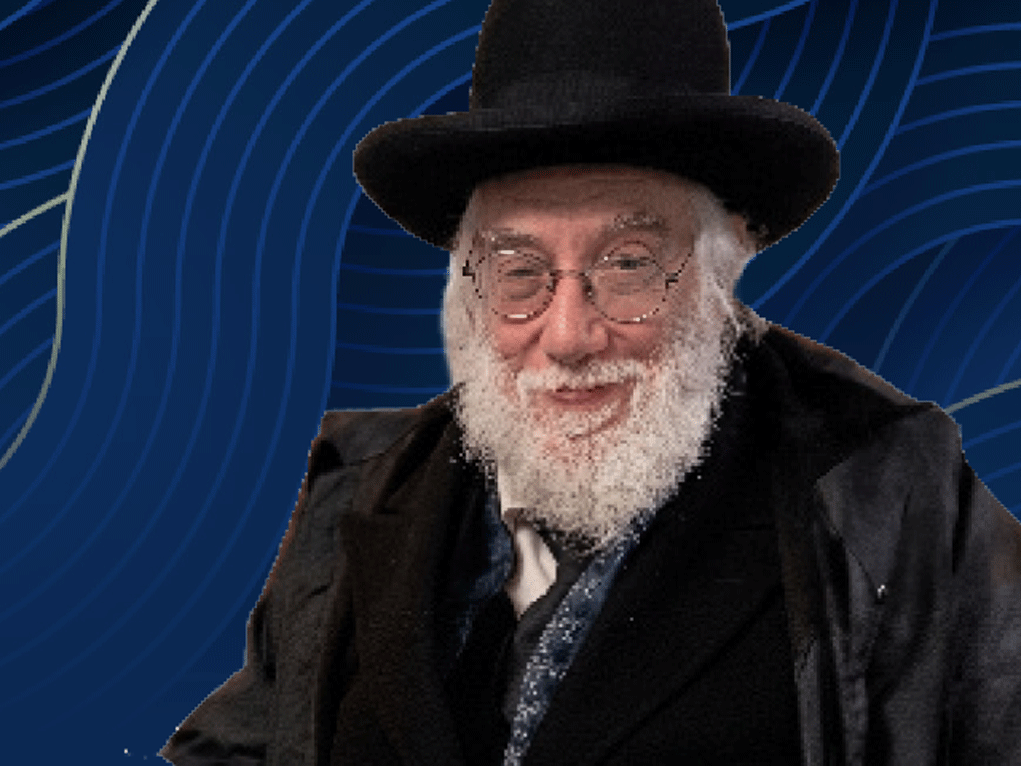
Rav Chanoch Aryeh Friedman zt”l


By Rav Michoel Sorotzkin

There are lives that impress, lives that inspire, and lives that quietly but indelibly redefine what a ben Torah can be. And then there are the rare lives that seem to belong less to the ordinary rhythms of this world than to a higher orbit altogether, lives of such constancy in Torah, such refinement in middos, such fidelity to truth, that when they are taken from us, we feel not merely the absence of a man, but the sudden dimming of a luminous world. With the petirah of Rav Chanoch Aryeh Friedman, the olam haTorah has suffered precisely such a loss. “Vayishalech Chanoch es haElokim ve’eineno ki lokach oso Elokim.” The posuk seems to have been written for such a moment, for such a person, for such a man. He lived a life of Elokus, of palpable dveikus, of relentless avodah and unembellished greatness, and then, in a manner as painful as it was awe-inspiring, he was taken from us.

His final days themselves seemed to reflect the pattern of his entire life. He had come to America not for rest, but in order to strengthen and sustain the great Torah citadel he had built, Kollel Bais Yechiel in Har Nof. Even in weakness and suffering, his concern was for Torah, for talmidim, for the continuation of a makom that had become synonymous with hasmodoh, halachic clarity, and the quiet transmission of greatness. There is something almost unbearably moving in that image: a man already refined by decades of avodah, then further “nizdacheich b’yissurim,” while still engaged in the sacred burden of carrying Torah on his shoulders.

Rav Chanoch was not the product of the familiar old-world mold. He grew up in Chicago in a family whose environment was more in the baalei batishe world, respectable, and deeply committed, but not the natural habitat from which one would predict the emergence of a gadol b’Torah. Yet perhaps it was precisely there that one first sees the remarkable foundations that would define him. His father, Mr. Yosef Friedman, an attorney by profession, was known as an osek b’tzorchei tzibbur b’emunah, a man of uncommon integrity, nikayon kappayim, and profound kavod haTorah. He possessed the wisdom to recognize what his son was destined for, and the courage to allow it. When the young Chanoch, already renowned as an iluy with phenomenal hasmodah and a prodigious memory, was sent as a teenager to the Skokie Yeshiva, it could have been assumed that this was the natural path. Yet his father agreed to let his sixteen-year-old son leave that environment and go into golus l’makom Torah, to bask beneath the waning but still fiery sun of Rav Aharon Kotler in Lakewood.

That decision altered not only one life, but the lives of generations. In Bais Medrash Govoah, he became the youngest talmid in the yeshiva, learning b’chavrusa with Rav Moshe Hillel Hirsch, and absorbing from Rav Aharon not only Torah content but the very grammar of utter seriousness in avodas Hashem. From there, he journeyed to Yerushalayim, to the Mir, where he became one of the outstanding talmidim of Rav Nochum Partzovitz and a frequenter of the home and orbit of Rav Chaim Shmulevitz. These are biographical details, yes, but more importantly, they help explain the unmistakable texture of the man he became: the breadth of the American beginning, the fire of Lakewood, the lomdus and depth of Mir, and over all of it an inner discipline that made everything cohere into one seamless avodah.

He was a marbitz Torah in the deepest sense of the phrase. As rosh kollel and av beis din of Bais Yechiel, he shaped bnei Torah not merely through shiurim and psak, though in both he was exceptional, but through the force of his very being. His halachic rulings were marked by fairness, precision, and sensitivity. His shiurim were deep and analytic, yet never merely clever. He was one of those rare roshei kollel whose iyun sharpened the mind while simultaneously ennobling the soul. Those who came to him for din Torah or for horaah encountered not only a powerful intellect, but a conscience governed entirely by Torah truth.

Yet perhaps the most astonishing feature of Rav Chanoch was the scale and consistency of his personal avodah. He completed Shas every single year, marking the siyum during hakafos shniyos in his bais medrash in Har Nof. This emerged from a private regimen of almost unimaginable discipline. Bavli, Yerushalmi, Shisha Sidrei Mishnah, daily learning in Shulchan Aruch, the morning iyun seder with the yungeleit, a longstanding chavrusa of decades, public leadership, private counsel, communal responsibility, and yet the wheel never stopped turning. This was not the feverish energy of a man chasing accomplishments. It was the settled rhythm of someone for whom Torah had become the very atmosphere of life.

And in that lies one of the deepest lessons of his life. At his siyumim, he would tell people with disarming simplicity, “Gam atem yecholim.” Not everyone could be Rav Chanoch Friedman, but he genuinely believed that people vastly underestimate the kochos hanefesh and the siyatta diShmaya that emerge when one accepts a real kabbolah. He would cite the Chofetz Chaim that when a person resolves with authenticity to fulfill a commitment regardless of difficulty, Heaven assists him. And he testified that he had seen it in his own life, that at moments when nature dictated he could not possibly keep pace with his learning obligations, he began, and from Shomayim he was carried further. That statement, in his mouth, was not rhetoric. It was the distilled theology of a lifetime.

It is especially fitting that he became the publisher of the writings of the Chofetz Chaim on the Torah. This was not simply a literary or scholarly undertaking. The Chofetz Chaim was his model in the architecture of the soul. One sensed in Rav Chanoch the same reverence for every word of Torah, the same vigilance in bein adam lachaveiro, the same refusal to allow brilliance to outpace purity. He did not merely learn the Chofetz Chaim’s Torah; he labored to inhabit his world. There are talmidei chachomim who quote seforim, and there are talmidei chachomim who are quietly shaped by them until the sefer becomes a living presence in their character. Rav Chanoch belonged to the latter category.

He himself taught that when Chazal say “Ein lo l’HaKadosh Boruch Hu b’olomo ela daled amos shel halacha,” one who emerges as a true moreh horaah is precious beyond measure, because so few traverse the long road from possibility to actual psak. He spoke of the innocent image of the child, “pnei keruvim k’pnei tinok,” as a model for the one who would grow in Torah with both unquenchable hunger and purity of mind. He described talmidei chachomim as “eish,” because unlike water, wind, or earth, fire transforms whatever touches it into fire. So did he live. Those who encountered him were warmed, illuminated, and in some measure ignited.

On a personal note, I cannot think of the Friedman family without recalling a memory from my youth. After my own father’s petirah, when I arrived in America as a fresh yasom, Mr. Yosef Friedman and his wife, Mrs. Zlata Golda, invited me to their home in Chicago for Yom Tov Sukkos, as my sister just married Reb Chanoch’s younger brother, a great talmid chochom in his own right, Rav Avrohom Friedman, who later became the rosh yeshiva of Skokie Yeshiva in Chicago. They enveloped me with extraordinary warmth. I remember vividly that as soon as I entered, Mr. Friedman told me that I had the zechus to sleep in a bed on which three gedolei Yisroel had slept: the Ponovezher Rov, Rav Aharon Kotler, and “my son Chanoch,” then a young yungerman of already legendary promise, about whom Rav Aharon himself had spoken in glowing terms. The next morning, he asked me with a smile, “How was it to sleep in the bed of gedolei Yisroel?” It was a charming remark, but it was also more than that. It revealed a home in which kavod haTorah was not decorative, but breathable. In retrospect, one understands that the father who cherished Torah so instinctively was privileged to raise a son who would become one of its finest embodiments.

In an age hungry for noise, Rav Chanoch represented the majesty of the unadvertised gadol. His anovah was as striking as his scholarship. His dignity was matched by warmth. His greatness did not need staging, because it issued from decades of hidden labor before Hashem. Such men do not leave replacements. They leave obligations. They leave the haunting summons of “Gam atem yecholim.” And above all, they leave behind the echo of a life that walked with Hashem. “Vayishalech Chanoch es haElokim ve’eineno ki lokach oso Elokim.”

***

By Yosef Goldstein

Rav Chanoch Friedman passed away on Motzoei Pesach. He was the rosh kollel of Kollel Beis Yechiel in Yerushalayim and av bais din of Beis Din Choshen Mishpot of Har Nof. Rav Chanoch grew up in Chicago during the 1960s. At that time, the norm was for boys to learn a profession to support themselves; Torah learning was not seen as essential. Most of his relatives were not observant, and he was brought up in a traditional environment. Nevertheless, he became one of the world’s greatest talmidei chachomim, completing Shas Bavli, Yerushalmi, and Mishnayos every year; he mastered and memorized them to the extent that he could quote any passage word for word. He was a tremendous masmid mastering the entire Ketzos Hachoshen, Avnei Miluim, all the seforim of the Chofetz Chaim, and many other seforim as well.

Rav Chanoch was blessed with extraordinary intellectual abilities. Rav Aharon Kotler described him as a true iluy. As a young boy, he was influenced by Rav Peretz, a talmid of the Slabodka Yeshiva, who instilled in him a deep love for learning. At age twelve, he was even happy to contract pneumonia so he could stay home from school and complete a masechta in time for his bar mitzvah.

At fourteen, recognizing his passion for Torah, his father sent him to the Skokie Yeshiva beis medrash, skipping high school entirely — an almost unheard-of decision at the time.

His dedication only intensified. While there, he organized a nightly chaburah at midnight. The rosh yeshiva, Rav Rogoff, would regularly test him. When asked what material he wished to be examined on, Rav Chanoch would simply respond, “Anything you choose.”

At sixteen, Rav Mendel Kaplan sent him to Lakewood to learn under Rav Aharon Kotler. During his entrance examination, he recited sections of Minchas Chinuch by heart. Rav Aharon accepted him, making him the youngest student in the yeshiva.

His hasmodah was exceptional. Each Simchas Torah, he would purchase Atah Horeisa for one thousand blatt Gemara, and he would personally complete any portion others could not finish. When the yeshiva began learning Bava Basra, he approached Rav Aharon and requested permission to learn a different masechta since he had already mastered it. After testing him, Rav Aharon agreed and remarked that Rav Chanoch was the greatest talmid chochom among the bochurim he knew.

He later continued his learning in the Mir Yeshiva in Eretz Yisroel, where he was again recognized as an iluy and extraordinary masmid. Rav Chaim Shmulevitz chose to learn with him as a chavrusa. It is related that he once alternated reciting entire blatt Gemara by heart, both Bavli and Yerushalmi, with another prodigious scholar. Rav Chanoch considered himself a close disciple of Rav Nochum Partzovitz, authoring seforim discussing Rav Nochum’s teachings.

Beyond his diligence, he devoted himself to refining his middos. He mastered the writings of the Chofetz Chaim and compiled them into organized works, including Likutei Chofetz Chaim al HaTorah. Notably, he published these anonymously, describing himself only as “an avreich who wishes to benefit the public.” He also authored an index to Ketzos HaChoshen long before digital tools existed. Rav Nochum attributed Rav Chanoch’s vast Torah knowledge to his efforts in spreading the teachings of the Chofetz Chaim.

His scholarship spanned all areas of Torah. In addition to completing Shas annually, he learned in depth with his kollel and issued halachic rulings in Choshen Mishpot. He authored dozens of seforim across a wide range of topics, including a work with 21 essays on Rav Chaim Soloveitchik’s teachings on Ohalos.

He traveled twice a year internationally to raise funds for his kollel yet never compromised his rigorous schedule. He would not begin fundraising until he had completed his daily learning quota. He also maintained long-distance chavrusos, learning by phone for sessions lasting up to six hours.

He was never seen without a Gemara. At every event, even family celebrations, he remained immersed in learning. At his granddaughter’s wedding, he sat at the head table absorbed in a sefer, and visitors had to wait until he realized that they were there.

Despite this, he maintained a deep emotional connection with his family. He refused to travel for Shabbos or Yom Tov to avoid disrupting his learning, but his family would visit briefly during Chol Hamoed, experiencing genuine warmth and affection in those moments. He even called his sister daily to check on her.

He davened vasikin every day. On Shabbos mornings in Chicago, he would return from vasikin, eat briefly, and learn continuously until Mincha, asking if there was still fleishig food for seuda shlishis. This routine was consistent, even in the long summer afternoons. People would regularly find him learning late into Friday night before making Kiddush.

This past Tzom Gedaliah, he was found in shul long after the fast had ended, still learning. When food was brought to him, he insisted on finishing his learning first.

He had no interest in material comforts. After his wife passed away, he asked only for simple food — plain boiled chicken and potatoes, without seasoning.

Even in illness, his commitment remained absolute. While hospitalized, after drinking water, he insisted on walking four amos in accordance with halacha, despite great difficulty.

Though he could barely speak toward the end of his life, when he heard his daughter counting Sefirah, he whispered along. Visitors would come for brachos, and although it was difficult for him to respond, requests related to Torah would visibly energize him.

Near the end, on Motzoei Pesach, his longtime chavrusa, Rav Moshe Hillel Hirsch, urged doctors to do what they can to extend his life, saying his very existence was a merit for the world. Shortly afterward, Rav Chanoch passed away, but his legacy endures.

All credit goes to the author and the Yated.

Gedolei Torah View on Har HaBayis- a Halachic Analysis

By Rabbi Yair Hoffman as seen on YWN all credit goes to both of them


By Rabbi Yair Hoffman for 5tjt.com

Recently, President Yitzchok Herzog indicated to the leaders of the Shas party that one of the greatest political challenges that lies ahead is in the negotiations about the status quo of the Temple Mount.

He said that Itamar Ben-Gvir, the head of Otzma Yehudit, is feared around the world. President Herzog made the comment when he thought that the microphones were not recording a hot mike.

There is one topic that I did not raise because I did not want to attack anyone. You will have a problem with the Temple Mount. This is a critical issue. You have a partner who all the world around us is fearful of. I also told him this between us. Really this is not for publication. I don’t want to make trouble, but I think you have a responsibility.

President Herzog is named after his illustrious grandfather, Rav Yitzchok Herzog. His grandfather, however, would have felt that it was actually a very serious halachic challenge.

The Gedolei Torah throughout the Doros would have agreed.

According to traditional Judaism, the Temple Mount is certainly the holiest, holiest place in our physical universe.Both Mr. Ben Gvir and Mr. Smotrich are clearly bent on ensuring Jewish sovoreignty on Har HaBayis  which is a laudable and admirable ideal. However, it must be done within the halachic guidelines of the greatest of our Torah sages. What follows is an analysis of the underlying issues.

WHY IS IT CALLED HAR HABAYIS?

Muslims call the Temple Mount the Haram al Sharif. But the name, Har HaBayis is far far older. Lets not forget that Muslims invaded Eretz Yisroel only at the year 661 CE. The two mosques that are found on Har HaBayis were completed in the year 692 CE.

Where does the name Har HaBayis come from?

Rav Shimshon ben Abraham of Sens (c. 1150-c.1230),was one of the leading students of Rabbeinu Tam. He is known as the Rash MiShantz and is the Rashba that is cited in Tosfos. In his commentary on the Mishnah (Midos 2:1), he writes that the name is based upon a verse in Isaiah (2:2), Nachon yiheye har bais hashem brosh heharim  The mountain of Hashem will be on mountaintops.


WHERE IS IT LOCATED?

In order to determine whether we may at all enter Har HaBayis, we must first get a background in the geography of the area and where Har HaBayis is located, and then some of the history.

THE GEOGRAPHY

The Kidron Valley, Nachal Kidron, is the valley on the eastern side of the Old City of Jerusalem, separating Har HaBayis from Har HaZeisim. It continues eastward through the Judean Desert, toward the Dead Sea. It travels some 20 miles, and slopes downward in terms of elevation, a total of 4000 feet along the way.

In TaNach it is called Emek Yehoshafat or Valley of Jehosophat. It appears in the prophecies of Klal Yisroel regarding Moshiach, which include the return of Eliyahu HaNavi, followed by the arrival of Mashiach, and Milchemes Gog uMagog, and Judgment Day.

The Tyropoeon Valley (also known as the Valley of the Cheesemakers) is the name given by Josephus the historian (Wars of the Jews 5:140) to that part of the valley that was within the Old City of Jerusalem.

Once, this valley separated Har haBayis from Har Tzion Zion and emptied into the valley of Hinnom. This is no longer true. The Tyropoeon Valley is now completely filled up with debris, and has become a plain of sorts.

It is spanned by bridges including Zion Bridge. The bridges were the method of communication between Herods palace on Har Tzion and the Bais HaMikdash.

HAR HABAYIS

So where is Har HaBayis? It is what forms the northern portion of the narrow part of that hill that slopes from the north to the south. It rises above the Kidron Valley to the east and Tyropoeon Valley to the west. The slope from north to south is very sharp.

The peak of Har HaBayis reaches a height of 2,428 feet above sea level.

THE HISTORY

In around the year 19 BCE, Herod the Great extended the natural plateau of Har HaBayis by enclosing the area with four massive retaining walls and filling up the areas with earth and rocks.

This artificial expansion resulted in a large flat area. This flat area is now what makes up the eastern section of the Old City of Jerusalem. The trapezoid shaped platform measures a total of 37 acres. Its dimensions are 488 meters on the west side, 470 meters on the east side, 315 meters on the north and 280 meters on the south side. In total it is approximately 150,000 square meters.

The northern wall of the Temple Mount, together with the northern section of the Kosel, is hidden behind buildings.

The southern section of the western side is open and is the Kosel as we know it. The plaza behind the Kosel was made by city planners after we had recaptured eastern Yerushalayim after 1967.

The retaining walls on these northern and western sides go down many meters below the ground. A northern portion of wall on the west may be seen from within the Western Wall Tunnel, which was recently excavated through some of the buildings.

On the southern and eastern sides the retaining walls are almost completely visible to their full original height. The platform itself was separated from the rest of the Old City by the Tyropoeon Valley. This valley is no longer the deep valley it was, however.

The platform can be reached through a street in the Muslim Quarter called Bridge Street a funny name. Presumably, it is called that because it is a street on a huge bridge but the area that was below the bridge was filled up. However, you can still see that it was once a bridge from the view in the Western Wall Tunnel.

Now lets get to the Halachic section.

WHY MOST POSKIM FORBID

As mentioned in the beginning, most major poskim forbid walking on Har HaBayis nowadays. Some Rabbis disagree with them, however. Those Rabbis who permit it draw a distinction between the current area of the Temple Mount and the dimensions of Har HaBayis that are discussed in the mishnah in Midos (2:1).

DISCREPANCY BETWEEN MISHNA AND NOW

The Mishnah tells us that Har HaBayis is 500 amos by 500 amos. The current area of Har HaBayis is 1,601 feet by 1,542 feet. On the north-south side, it is less (1,033 and 919 feet).

The first supposition that those who permit it make is that the current state of Har HaBayis is that it is double the size of what is mentioned in the mishnah.

THREE PROBLEMS

There are at least three problems with this. Firstly, Torah sources sometimes round off or approximate measurements. The number 500 by 500 can certainly be an approximation. It also may be a total square ammahage, so to speak.

The second problem is that we do not know the exact dimensions of an amah. Some say it is 18 inches; others say 21.25 inches or 23 inches; and a good argument can be made that it is less than 18 inches as well.

The third problem is that the midos discussed in the Mishna may have or may not have included the thickness of the wall – which may have been 27 feet thick according to some sources  this could make it better or make it worse. It could also have referred to an early thickness of the wall rather than a later one.

A FOURTH PROBLEM

There is also the view of Rav Emanuel Rikki in his Aderes Eliyahu in a Kuntrus Mei Niddah #37 that for matters of Kodesh – an Ammah is different  it is an Ammah and 2/3. Now, one may think that this ridiculous, but Rav Rikki is the author of one of the most fundamental texts in Kabbalah. The Vilna Gaon held him in very high esteem.

If Rav Rikki is, in fact, correct then we have to re-analyze what Herod did exactly and the expansions that he made. Do we really want to deny the Kabbalistic traditions here?

All these four factors alone throw a serious monkey-wrench into the calculations of those who permit treading upon the most holiest place in the universe.

A NEW ISSUR

The second supposition made by those who permit entry onto Har HaBayis is that Rashis pshat in the Gemara in Yevamos (7b) is in error. Most Poskim contend, however, that Rashis pshat is the authoritative understanding of the underlying issue, and has been the normative halachah for many centuries.

But lets give a brief background.

Yehoshafat, the king of Yehudah, was under intense pressure. The powerful armies of Ammon, Moav, and Seir had combined forces to attack Eretz Yisrael (see Divrei HaYamim II 20:5).

WHAT IS CHATZER CHADASH?

Frightened, Yehoshafat turned to Hashem, declared a fast, and gathered the people to Yerushalayim to the Beis HaMikdash to daven fervently to Hashem. He davened in the new courtyard.

THREE INTERPRETATION TO NEW COURTYARD

There are three interpretations to the term new courtyard.

  • The RaDak and Metzudas Dovid both suggest that it is possible that some sort of improvement was made in the courtyard.
  • The Gemara in several places, according to Rashi, tells us that there was a new enactment involving the Beis HaMikdash, promulgated at that very time, forbidding a tvul yom from entering into the Camp of the Leviim-the Temple Mount. This additional enactment endowed the entire Makom HaMikdash with a higher level of sanctity. The term new courtyard refers to this new enactment, and the courtyard that is referenced is the entire area.
  • The third interpretation is that the new courtyard refers to the ezras nashim only.

AUTHORITATIVE PSHAT

The Kaftor Vaferach (a Rishon who tells us the minhagim of the Jews in Eretz Yisrael and the Makom HaMikdash) in chapter six tells us that Jews observe the second definition of new courtyard as being the exact walls of the then current Har HaBayis. Since he lived in the 1300s, the reference is to our contemporary wall dimensions.

The Teshuvas Ramoh (#25) cites this ruling as authoritative and, until very recently, it has always been observed.

The Sefer HaManhig (s.v. Baal keri), citing the rulings of the Geonim, explains that it was only during the Temple times that a tvul yom could immerse and wait a day. However, nowadays, when it is impossible to rid ourselves of the impurity of the dead, removing the tumah of baal keri is impossible while we still retain the impurity of the dead.

Why?

Because regarding a tvul yom it says, uvah hashemesh vtaher he needs to be completely tahor and on account of the fact that nowadays we have no way to purify this person cannot because he is still tamei mais. Lets not forget, however, that in the times of the Mishna and in the times of the early Yerushalmi – there was still a way to be metahair with Para Adumah ashes – and it was only lost much later.

So even though the mishnah in Keilim indicates that the impurity of the dead does not necessarily directly impinge upon going onto Har HaBayis itself, it does do so by not allowing our tumas keri to be completely removed.

THEY DISAGREE WITH THE CLASSICS

Those that advocate treading upon Har HaBayis either disagree with this Sefer HaManhig, with the Geonim he cites, or have figured some other reading of this Sefer HaManhig.

This position fits the normative practice cited in Rav Ovadiah Bartenuras letter to his father that Jews would not go up to Har HaBayis even if the Muslims would have allowed them (the letter is cited in the responsa by Dayan Weiss).

[It should be noted that Rav Moshe Feinstein I.M. O.C. vol. II #113 does seem to disagree with the Sefer HaManhigs understanding of undoing impurity, but the other issues are still relevant. Also, most of the other poskim seem to abide by the Sefer HaManhig.]

HIGHER THAN IT WAS

A third supposition that is made, is that the area of Har haBayis has placed layer after layer and it is much higher than it was originally. The Gemorah in Psachim 85b cites Rav as ruling that Gagin valiyos lo niskadshu.. Rashi explains that this refers to the roofs of Yerushalayim regarding kedushas yerushalayim for kadshim kalim or to the lishkos of the azarah roofs. In Shavuos 17b, Rashi writes that the gagin and aliyos were never sanctified  just the floors up to the roofs.

ATTEMPTED ANSWERS

There are a number of attempted answers to this. The first is that this concept is misunderstood because it refers to the original buildings. However, after the buildings are gone, the floored area still has kedusha and therefore when a building is built afterward the kedusha is not blocked. This is clear in the Radbaz itself (Siman 691). Furthermore, Rav Zelig Reuvain Bengis in his liflagos Reuvain volume 6 writes that this is only when there was a space, but if it is made of solid material there is still kedusha there.

Some, believe it or not, question the whole archaeology of it because it says aru aru ad hayesod bah that it was entirely destroyed down to the foundation. They suggest that it is not higher than it was.

IS THE AL SAKARA THE EVEN SHESIYA?

Another supposition made by those who advocate going onto Har HaBayis is that their measurements are accurate based upon the idea that the current rock known as the al Sakara is one and the same as the Even Shesiya discussed in the mishnah in Yuma. Many Torah authorities as well as secular archaeologists question this identification.

Some say that it is the Makom HaMizbeach (Rav Shlomo Goren). Others say that it is, in fact, the Even Shesiya.

WHY DID WE NEED NEVIIM?

If it is the Even Shesiya, another question arises. When the second Bais HaMikdash was rebuilt after our return from Bavel – why did they need neviim prophets to establish its location?

Why couldnt they calculate based upon this Even Shesiya that was known? This question is brought down in the Sefer Avodah Tamah. Some Poskim have concluded from the strength of this question that it is not the Even Shesiya.

WHERE WAS THE EVEN SESIYA IN TERMS OF THE BAIS HAMIKDASH?

But even if it is the Even Shesiya, where was the even shesiya in terms of the Beis HaMikdash? Was it in the center, the west side of it or the east side of it? Perhaps this was the safaik that they had when they built the second bais haMikdash and now it is known. The problem with this is that the debate is still after Bais HaMikdash #2.

Another problem is that the water coming in, which was used as a mikvah for purifying the Kohanim does not correlate well to this location as the even shesiyah. Drawing water from it would produce the problem of drawn water.- mayim she-uvim. There are a few solutions to this problem, but who knows which one is the accurate one?

THE RADBAZ

While some of those who advocate going onto the Temple Mount cite the Radbaz (responsa #691), who does make this identification with the even shesiya, there are some very serious discrepancies in the responsa of the Radbaz that have been pointed out by the leading poskim of the generation, including Rav Ovadiah Yoseph, Rav Waldenberg, ztl (Tzitz Eliezer vol. X #1), Dayan Weiss (vol. V #1), and Rav Betzalel Zolti.

ISSUES OF KAREIS

When dealing with an issue of Kareis the custom in Klal Yisrael has always been to be stringent. Here we have four leading poskim who tell us with very stern warnings, Stay Away!Also, when it was first recaptured in 1967, a letter went out signed by 52 of the top Poskim in eretz Yisroel. Why ignore them?

THE OLD PICTURE

A fourth assumption made by those who advocate treading upon Har HaBayis is based upon an old picture that was found of Har HaBayis. The assumption is that the raised platform in the photo is the actual Har HaBayis referred to in the mishnah. This too, however, has numerous problems.

There are further indications from various sources in the Acharonim that the walls extend past the areas pointed to in the picture (Peas HaShulchan by a student of the Vilna Gaon, Rav Yisroel of Shklov, Eretz Yisrael 3; addendum to Kaftor Vaferach).

RAAVAD VERSUS OTHERS

Many of those whose opinions promote going onto Har HaBayis do rely to some degree on the opinion of the Raavad, who rules that the sanctity of the Temple Mount is not as in force as it was when the Temple stood. Rambam, of course, disagrees, and the Mishnah Berurah and magain avrohom 561:2 rule fully in accordance with the Rambam.

This is also the overwhelming opinion of the Rishonim  I will list them: Sefer HaTruma in his Hilchos Eretz Yisroel, SMag mitzvas assei 163  he writes that what made it kadosh was the shechina and that never gets undone, whereas other issues were kadsh only leshaasa  a kivush for example regarding trumos and maasrosm Rashi avoda zara 13a venishchatai mishchat  we are obligated on shechutei chutz mideoraisa nowadays  like the rambam, Rash miShantz shviis 6:1, Tosfos Yuma 44a, shvuos 14b, Tosfos HaRosh yevamos 82b  gives a reason because it is called a nachalah which can never be undone, Yereim siman 277, Chinuch in ten different places 284, Tashbatz vol III #201, Rashba megillah daf yud , Ramban shavuos 14b, Ritvah Megillah 10b, and Kaftor vaFerach. Plus, we have the opinion that the Raavad was only referring to the deoraisa aspect of things but miderabanan he was machmir.

Who, among the Rishonim, rules like the Raavad? There is one tzad in the Meiri like this, but elsewhere he says that the psak is like the Rambam.

There is also the notion fund in Rav Chaim Soloveitchik zatzal that there are, two dinim, two types of laws, in the issue of the Temples holiness  kedusha. The Raavad was only referring to the kareis din but the other din of kedusha is still in effect even though there is no karais.

WHO IS A ZAV?

There is also the issue of whether everyone in contemporary times has the halachic status of a zav. Both Dayan Weiss and the Tzitz Eliezer rule that everyone does. Those who advocate for treading on Har HaBayis disagree with this contention.

Finally, Rav Kook (Mishpat HaKohein #96) himself writes that even according to the view of the Raavad, there is still a Rabbinic prohibition of entering the Temple Mount. He explains that Chazal felt that the reverence and respect for the Makom HaMikdash is greater in not going there, than in visiting it.

Modern advocates of treading on Har HaBayis indicate that Rav Kook would have changed his mind if he had been given their new evidence. But intellectual honesty would yield quite a different theory.

In short, the overwhelming view of poskim, chareidi and otherwise, simply do not agree that Jews may or should go up to Har HaBayis. While the sentiment is certainly understood, and one cannot fault those who genuinely believe that it is halachically permitted, it is still a very serious issue.

Rav Betzalel Zolti ztl in his Mishnas Yaavetz (OC Tisha BAv 47:4) writes that even someone who immersed properly in a Mikvah and purified himself from any Tumah that emits from his body is still prohibited from entering any of the area of Har HaBayis, as on account of the sheer passage of time we can no longer accurately identify the Makom HaMikdash. Whomsoever enters there is liable to accidentally enter the Mikdash or the Kodesh Kodashim, and would stumble Heaven forbid in the sever prohibition of Karais.

The author can be reached at yairhoffman2@gmail.com


Rabbis of LA | Rabbi Sochet Was Born to Be a Rabbi By Ari L. Noonan at the Jewish Journal

  All credit goes to the author and the Jewish Journal (Photo Credit:kahalchasidim.com) The Stoliner dynasty is about 250 years old, and one...