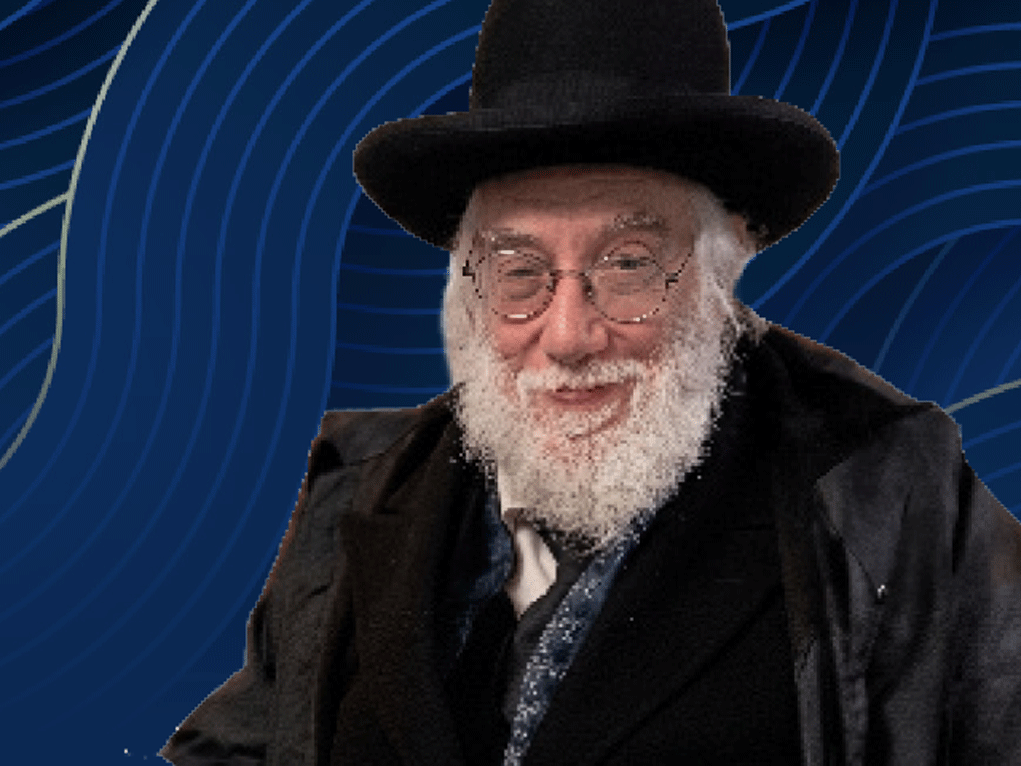
By Rav Michoel Sorotzkin
There are lives that impress, lives that inspire, and lives that quietly but indelibly redefine what a ben Torah can be. And then there are the rare lives that seem to belong less to the ordinary rhythms of this world than to a higher orbit altogether, lives of such constancy in Torah, such refinement in middos, such fidelity to truth, that when they are taken from us, we feel not merely the absence of a man, but the sudden dimming of a luminous world. With the petirah of Rav Chanoch Aryeh Friedman, the olam haTorah has suffered precisely such a loss. “Vayishalech Chanoch es haElokim ve’eineno ki lokach oso Elokim.” The posuk seems to have been written for such a moment, for such a person, for such a man. He lived a life of Elokus, of palpable dveikus, of relentless avodah and unembellished greatness, and then, in a manner as painful as it was awe-inspiring, he was taken from us.
His final days themselves seemed to reflect the pattern of his entire life. He had come to America not for rest, but in order to strengthen and sustain the great Torah citadel he had built, Kollel Bais Yechiel in Har Nof. Even in weakness and suffering, his concern was for Torah, for talmidim, for the continuation of a makom that had become synonymous with hasmodoh, halachic clarity, and the quiet transmission of greatness. There is something almost unbearably moving in that image: a man already refined by decades of avodah, then further “nizdacheich b’yissurim,” while still engaged in the sacred burden of carrying Torah on his shoulders.
Rav Chanoch was not the product of the familiar old-world mold. He grew up in Chicago in a family whose environment was more in the baalei batishe world, respectable, and deeply committed, but not the natural habitat from which one would predict the emergence of a gadol b’Torah. Yet perhaps it was precisely there that one first sees the remarkable foundations that would define him. His father, Mr. Yosef Friedman, an attorney by profession, was known as an osek b’tzorchei tzibbur b’emunah, a man of uncommon integrity, nikayon kappayim, and profound kavod haTorah. He possessed the wisdom to recognize what his son was destined for, and the courage to allow it. When the young Chanoch, already renowned as an iluy with phenomenal hasmodah and a prodigious memory, was sent as a teenager to the Skokie Yeshiva, it could have been assumed that this was the natural path. Yet his father agreed to let his sixteen-year-old son leave that environment and go into golus l’makom Torah, to bask beneath the waning but still fiery sun of Rav Aharon Kotler in Lakewood.
That decision altered not only one life, but the lives of generations. In Bais Medrash Govoah, he became the youngest talmid in the yeshiva, learning b’chavrusa with Rav Moshe Hillel Hirsch, and absorbing from Rav Aharon not only Torah content but the very grammar of utter seriousness in avodas Hashem. From there, he journeyed to Yerushalayim, to the Mir, where he became one of the outstanding talmidim of Rav Nochum Partzovitz and a frequenter of the home and orbit of Rav Chaim Shmulevitz. These are biographical details, yes, but more importantly, they help explain the unmistakable texture of the man he became: the breadth of the American beginning, the fire of Lakewood, the lomdus and depth of Mir, and over all of it an inner discipline that made everything cohere into one seamless avodah.
He was a marbitz Torah in the deepest sense of the phrase. As rosh kollel and av beis din of Bais Yechiel, he shaped bnei Torah not merely through shiurim and psak, though in both he was exceptional, but through the force of his very being. His halachic rulings were marked by fairness, precision, and sensitivity. His shiurim were deep and analytic, yet never merely clever. He was one of those rare roshei kollel whose iyun sharpened the mind while simultaneously ennobling the soul. Those who came to him for din Torah or for horaah encountered not only a powerful intellect, but a conscience governed entirely by Torah truth.
Yet perhaps the most astonishing feature of Rav Chanoch was the scale and consistency of his personal avodah. He completed Shas every single year, marking the siyum during hakafos shniyos in his bais medrash in Har Nof. This emerged from a private regimen of almost unimaginable discipline. Bavli, Yerushalmi, Shisha Sidrei Mishnah, daily learning in Shulchan Aruch, the morning iyun seder with the yungeleit, a longstanding chavrusa of decades, public leadership, private counsel, communal responsibility, and yet the wheel never stopped turning. This was not the feverish energy of a man chasing accomplishments. It was the settled rhythm of someone for whom Torah had become the very atmosphere of life.
And in that lies one of the deepest lessons of his life. At his siyumim, he would tell people with disarming simplicity, “Gam atem yecholim.” Not everyone could be Rav Chanoch Friedman, but he genuinely believed that people vastly underestimate the kochos hanefesh and the siyatta diShmaya that emerge when one accepts a real kabbolah. He would cite the Chofetz Chaim that when a person resolves with authenticity to fulfill a commitment regardless of difficulty, Heaven assists him. And he testified that he had seen it in his own life, that at moments when nature dictated he could not possibly keep pace with his learning obligations, he began, and from Shomayim he was carried further. That statement, in his mouth, was not rhetoric. It was the distilled theology of a lifetime.
It is especially fitting that he became the publisher of the writings of the Chofetz Chaim on the Torah. This was not simply a literary or scholarly undertaking. The Chofetz Chaim was his model in the architecture of the soul. One sensed in Rav Chanoch the same reverence for every word of Torah, the same vigilance in bein adam lachaveiro, the same refusal to allow brilliance to outpace purity. He did not merely learn the Chofetz Chaim’s Torah; he labored to inhabit his world. There are talmidei chachomim who quote seforim, and there are talmidei chachomim who are quietly shaped by them until the sefer becomes a living presence in their character. Rav Chanoch belonged to the latter category.
He himself taught that when Chazal say “Ein lo l’HaKadosh Boruch Hu b’olomo ela daled amos shel halacha,” one who emerges as a true moreh horaah is precious beyond measure, because so few traverse the long road from possibility to actual psak. He spoke of the innocent image of the child, “pnei keruvim k’pnei tinok,” as a model for the one who would grow in Torah with both unquenchable hunger and purity of mind. He described talmidei chachomim as “eish,” because unlike water, wind, or earth, fire transforms whatever touches it into fire. So did he live. Those who encountered him were warmed, illuminated, and in some measure ignited.
On a personal note, I cannot think of the Friedman family without recalling a memory from my youth. After my own father’s petirah, when I arrived in America as a fresh yasom, Mr. Yosef Friedman and his wife, Mrs. Zlata Golda, invited me to their home in Chicago for Yom Tov Sukkos, as my sister just married Reb Chanoch’s younger brother, a great talmid chochom in his own right, Rav Avrohom Friedman, who later became the rosh yeshiva of Skokie Yeshiva in Chicago. They enveloped me with extraordinary warmth. I remember vividly that as soon as I entered, Mr. Friedman told me that I had the zechus to sleep in a bed on which three gedolei Yisroel had slept: the Ponovezher Rov, Rav Aharon Kotler, and “my son Chanoch,” then a young yungerman of already legendary promise, about whom Rav Aharon himself had spoken in glowing terms. The next morning, he asked me with a smile, “How was it to sleep in the bed of gedolei Yisroel?” It was a charming remark, but it was also more than that. It revealed a home in which kavod haTorah was not decorative, but breathable. In retrospect, one understands that the father who cherished Torah so instinctively was privileged to raise a son who would become one of its finest embodiments.
In an age hungry for noise, Rav Chanoch represented the majesty of the unadvertised gadol. His anovah was as striking as his scholarship. His dignity was matched by warmth. His greatness did not need staging, because it issued from decades of hidden labor before Hashem. Such men do not leave replacements. They leave obligations. They leave the haunting summons of “Gam atem yecholim.” And above all, they leave behind the echo of a life that walked with Hashem. “Vayishalech Chanoch es haElokim ve’eineno ki lokach oso Elokim.”
***
By Yosef Goldstein
Rav Chanoch Friedman passed away on Motzoei Pesach. He was the rosh kollel of Kollel Beis Yechiel in Yerushalayim and av bais din of Beis Din Choshen Mishpot of Har Nof. Rav Chanoch grew up in Chicago during the 1960s. At that time, the norm was for boys to learn a profession to support themselves; Torah learning was not seen as essential. Most of his relatives were not observant, and he was brought up in a traditional environment. Nevertheless, he became one of the world’s greatest talmidei chachomim, completing Shas Bavli, Yerushalmi, and Mishnayos every year; he mastered and memorized them to the extent that he could quote any passage word for word. He was a tremendous masmid mastering the entire Ketzos Hachoshen, Avnei Miluim, all the seforim of the Chofetz Chaim, and many other seforim as well.
Rav Chanoch was blessed with extraordinary intellectual abilities. Rav Aharon Kotler described him as a true iluy. As a young boy, he was influenced by Rav Peretz, a talmid of the Slabodka Yeshiva, who instilled in him a deep love for learning. At age twelve, he was even happy to contract pneumonia so he could stay home from school and complete a masechta in time for his bar mitzvah.
At fourteen, recognizing his passion for Torah, his father sent him to the Skokie Yeshiva beis medrash, skipping high school entirely — an almost unheard-of decision at the time.
His dedication only intensified. While there, he organized a nightly chaburah at midnight. The rosh yeshiva, Rav Rogoff, would regularly test him. When asked what material he wished to be examined on, Rav Chanoch would simply respond, “Anything you choose.”
At sixteen, Rav Mendel Kaplan sent him to Lakewood to learn under Rav Aharon Kotler. During his entrance examination, he recited sections of Minchas Chinuch by heart. Rav Aharon accepted him, making him the youngest student in the yeshiva.
His hasmodah was exceptional. Each Simchas Torah, he would purchase Atah Horeisa for one thousand blatt Gemara, and he would personally complete any portion others could not finish. When the yeshiva began learning Bava Basra, he approached Rav Aharon and requested permission to learn a different masechta since he had already mastered it. After testing him, Rav Aharon agreed and remarked that Rav Chanoch was the greatest talmid chochom among the bochurim he knew.
He later continued his learning in the Mir Yeshiva in Eretz Yisroel, where he was again recognized as an iluy and extraordinary masmid. Rav Chaim Shmulevitz chose to learn with him as a chavrusa. It is related that he once alternated reciting entire blatt Gemara by heart, both Bavli and Yerushalmi, with another prodigious scholar. Rav Chanoch considered himself a close disciple of Rav Nochum Partzovitz, authoring seforim discussing Rav Nochum’s teachings.
Beyond his diligence, he devoted himself to refining his middos. He mastered the writings of the Chofetz Chaim and compiled them into organized works, including Likutei Chofetz Chaim al HaTorah. Notably, he published these anonymously, describing himself only as “an avreich who wishes to benefit the public.” He also authored an index to Ketzos HaChoshen long before digital tools existed. Rav Nochum attributed Rav Chanoch’s vast Torah knowledge to his efforts in spreading the teachings of the Chofetz Chaim.
His scholarship spanned all areas of Torah. In addition to completing Shas annually, he learned in depth with his kollel and issued halachic rulings in Choshen Mishpot. He authored dozens of seforim across a wide range of topics, including a work with 21 essays on Rav Chaim Soloveitchik’s teachings on Ohalos.
He traveled twice a year internationally to raise funds for his kollel yet never compromised his rigorous schedule. He would not begin fundraising until he had completed his daily learning quota. He also maintained long-distance chavrusos, learning by phone for sessions lasting up to six hours.
He was never seen without a Gemara. At every event, even family celebrations, he remained immersed in learning. At his granddaughter’s wedding, he sat at the head table absorbed in a sefer, and visitors had to wait until he realized that they were there.
Despite this, he maintained a deep emotional connection with his family. He refused to travel for Shabbos or Yom Tov to avoid disrupting his learning, but his family would visit briefly during Chol Hamoed, experiencing genuine warmth and affection in those moments. He even called his sister daily to check on her.
He davened vasikin every day. On Shabbos mornings in Chicago, he would return from vasikin, eat briefly, and learn continuously until Mincha, asking if there was still fleishig food for seuda shlishis. This routine was consistent, even in the long summer afternoons. People would regularly find him learning late into Friday night before making Kiddush.
This past Tzom Gedaliah, he was found in shul long after the fast had ended, still learning. When food was brought to him, he insisted on finishing his learning first.
He had no interest in material comforts. After his wife passed away, he asked only for simple food — plain boiled chicken and potatoes, without seasoning.
Even in illness, his commitment remained absolute. While hospitalized, after drinking water, he insisted on walking four amos in accordance with halacha, despite great difficulty.
Though he could barely speak toward the end of his life, when he heard his daughter counting Sefirah, he whispered along. Visitors would come for brachos, and although it was difficult for him to respond, requests related to Torah would visibly energize him.
Near the end, on Motzoei Pesach, his longtime chavrusa, Rav Moshe Hillel Hirsch, urged doctors to do what they can to extend his life, saying his very existence was a merit for the world. Shortly afterward, Rav Chanoch passed away, but his legacy endures.
All credit goes to the author and the Yated.



No comments:
Post a Comment