| Magazine Feature |
| November 25, 2025
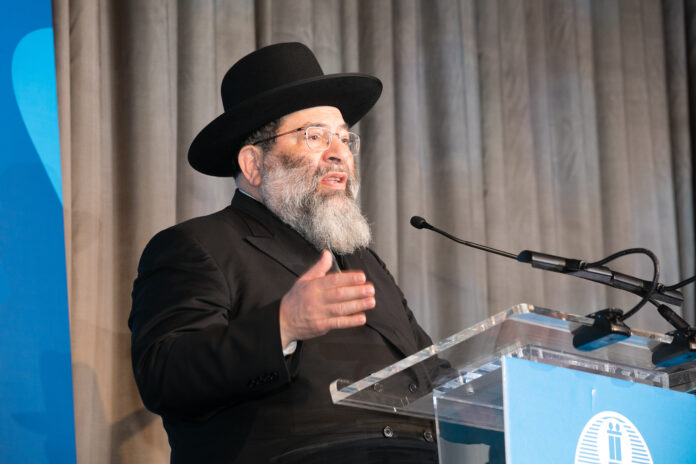
“How could you endorse Mamdani?” Tough questions for Satmar askan Rabbi Moishe Indig

Rabbi Moishe Indig never wanted to be a communal askan, yet this reluctant leader has been able to sway elections and accrue political friends with his valuable endorsements — even the virulent anti-Semite Zohran Mamdani. But Rabbi Indig says he has nothing to apologize for. “I’ve been working with unabashed anti-Semites for years,” he says. “My approach is always that you catch more flies with honey”
For 25 years, Rabbi Moishe Indig’s door has been a mandatory destination for anyone seeking public office in New York. The legendary political strategist and leader of the Satmar kehillos of Williamsburg and Boro Park leverages a bloc of thousands of votes, and candidates on every level learn early that they would be wise to win him over to their side.
Indig insists he never wanted anything to do with askanus — he was drafted into the role by legendary Satmar rosh hakahal Rabbi Yitzchok Rosenberg and tried numerous times to get out of it.
“This isn’t for me,” he would complain to Rabbi Rosenberg. “Choose someone else. I want out.”
“You can’t,” Rabbi Rosenberg often answered, “Not in this gilgul. It’s in your blood. Even if you had a transfusion, it won’t leave.”
Indig is the founder and leader of the Williamsburg Jewish Community Council, which responds to about 80 requests per day for help with various complex issues, from political flexing to government services and even immigration.
The reluctant leader has frequently played the role of political kingmaker, swaying more votes in an election than the margin of difference between winners and losers. His valuable endorsement can be the easiest thing to gain for some, but impossibly difficult for others. It has also proved surprising again and again, as he has stood loyally and unflinchingly by some candidates unpopular within the community — and without.
Perhaps his most shocking endorsement came several weeks ago, when he backed socialist candidate Zohran Mamdani for mayor despite his widespread reputation for virulent anti-Semitism — to the shock, consternation, and condemnation of layers of leaders, laymen, and powerbrokers.
Why did he do it? What did he get in exchange? And what’s next on his list of political alliances? We sat down with Rabbi Indig to get a sense of how he operates.
What are your general principles in askanus?
My number-one rule is never to tell someone, “It’s not my problem.” When I was young and newly married, I had trouble with an insurance technicality. I asked a person in a position of power for help, and he said, “This is your problem, not mine. I don’t have time to help you, what do you want from me?”
Since that moment — as I tell all my staff, paid and volunteer, at the JCC or other places — I made it a rule never to tell a caller “We don’t deal with this.” We may not deal with it directly, but there is always some way we can help. There are connections, people, someone in the Rolodex, chavrach chavra isa lei — we know a guy who knows a guy — there some way we can guide them, no matter what it is. That’s the definition of askanus and that is what it’s all about.
Aren’t you most well-known for political influence?
That’s just as a tool to help people in the community with their needs. Many candidates ask, “What do you want from me?” I always tell them that I don’t want anything — just an open-door policy. We have a large community, a lot of people with a lot of issues. Often, it’s only the person on top — the elected official — who has the power or willingness to help. All we want is for them to be a friend, ready to listen, and help when we need it, if possible.
It’s easy for government employees to say no, because “yes” means they have to work harder for the same paycheck. We can take “no” for an answer as long as it’s for a good reason, but not just based on laziness. Sometimes having someone on top involved can turn it into a “yes.”
How do you decide which candidates to back?
There’s never just one issue or factor to consider; you have to take the whole picture into account. Generally speaking, our priorities work as follows:
- If there is an incumbent running to stay in office, and he or she has a working relationship with the community, we will be loyal to them. Voting someone out is like firing them, that’s a whole different level of rejection than declining to support a new candidate. This has been a principle of our community for 80 years, since we built a presence here after the Holocaust.
- If there’s no incumbent, we look for a person who has a track record of being helpful to the community — a friend with whom we have a relationship. Most candidates are coming from lower office, and we have prior experience with them.
- The most difficult choice is when you have multiple established friends running for the same seat. We only have one vote to spend, but we need to be loyal to all friends. In a case like this, all things being equal, we will usually go with the candidate who has a good chance of winning. There’s no point in wasting time, money, and energy for someone who has no chance of making it.
For example, when Bill de Blasio was running in the NYC mayoral primary, another candidate demanded our support. I said, “You’re right, you are a friend, you helped us. But you’re at two percent. I can’t get you from two percent to 50 percent.” DeBlasio was not the front-runner, but with our endorsement, he was able to get over the top and win. People called me crazy for supporting him. But in the end he won by just a few thousand votes; our support made the difference, and he was indebted to us. The same occurred with Eric Adams.
Have you ever had to work with true anti-Semites in positions of power in the past?
All the time! I’ve been working with open, unabashed anti-Semites since the beginning. My approach is always that you catch more flies with honey. Don’t fight! I’m a Satmarer, and the Satmar shitah, taught to us by the Divrei Yoel, was always lo l’hisgaros b’umos, never antagonize the nations. It doesn’t make a difference what religion they observe — Christian, Muslim or whatever, do not fight. We’re in galus. We are grateful to have the privilege, baruch Hashem, in this malchus shel chesed, to have a say, to vote, to endorse or support whomever we feel would be best for us. But we do not use it as a weapon, do not go to war with anybody. That’s a big no-no.
The first anti-Semite in history was Eisav. And what did Yaakov do? He gave him piles of gifts. Ja, mein Herr. Yeah, I’m your slave, how are you? What else can I do for you? He hugged and kissed him even while Eisav was trying to bite him.
With this approach, we’ve won over many people.
For example, Brooklyn Borough President Antonio Reynoso was considered for years to be an outright enemy of our community, but now he’s a great friend. The same is true for Ed Day in Monsey, and many others.
You can even win people over who think they don’t need your vote. Emily Gallagher, state assemblywoman representing Williamsburg, told us blatantly, “I don’t need you. I don’t need your endorsement. I don’t need your support. I need nothing from your community. I’ll win without you and I want to have nothing to do with you.” Okay, we weren’t going to support her anyway, she was primarying Joe Lentol, an old friend. Joe was polling in the single digits, but our endorsement got a big turnout for him and he lost by just a few points. The night of the election, after seeing our loyalty and hakaras hatov, Gallagher was singing a different tune, calling and asking for a meeting to discuss collaboration. She subsequently developed into an invaluable asset for the community.
How did your relationship with Zohran Mamdani begin?
It started with a Jewish staffer, former chief of staff for our state assemblywoman Emily Gallagher. He had been very helpful to the community with Gallagher, and then went to work for Mamdani. He reached out to us several months before the primary, asking for a meeting. Mamdani was a back-of-the-pack candidate at the time, but our policy is that we meet with almost anyone who requests it. He came to visit us at the JCC.
I said to him, “The perception is that you are an anti-Semite. So I want to ask you straight out, are you an anti-Semite?”
He said, “No, I’m not an anti-Semite. I just don’t like what Israel is doing in Gaza.”
“Do you like what Russia is doing in Ukraine?” I countered.
“No, of course not,” he said.
“So how come no one hears about that?” I pressed him. “Is it that as a Muslim, the mistreatment of Muslims concerns you more than others?”
He explained that as an American, his activism is driven by the use of US taxpayer dollars to aid the war in Gaza. Russian aggression against Ukraine is not subsidized by the United States.
To us, that’s an untenable double standard, but I wasn’t looking to win a debate with him on foreign policy; I was looking for indications that in his mind — however much I disagree — it made sense to condemn Israel and still work with me.
“I promise you,” he continued, “I want to be your mayor, I want to be your friend, I want to work with your community and make sure your community will be happy with me, satisfied with me, and I promise they will like me. I’m here to work; I want to be everybody’s mayor.”
We talked about the issues affecting our community in New York City — education, public safety, housing, et cetera. It was like a good first date.
Why would you just take him at his word, when his rhetoric is consistently hostile to Jews, he aligns openly with anti-Semites, and offers no public apology or retraction?
He didn’t have anything to gain by convincing me that he was not an anti-Semite, and neither did I. He was going to win without a single vote from our community — he knew it and so did I. And I told him the story of Tony Cellini (see sidebar), making the point that I could work with him, even if he was a rabid anti-Semite. “But I’m not,” he said. “You won’t need to win me over, I’m already here.” At later meetings, he would refer back to that story and say, “You don’t need to work on me… I’ll prove the entire community wrong.”
I’ve been doing this for twenty-five years, and I know there was really no reason for him to pursue a relationship with us unless he meant it… but he did so, repeatedly working diligently to build a rapport.
Again, I’m not here to defend any of his objectionable positions or public statements. I’m here to establish the access to the halls of power so critically needed by our many communities. This was the time and address at which to do it — not after the election, coming like an esrog after Succos.
He issued a lukewarm condemnation last week to a demonstration blocking the entrance to the Park East Synagogue, chanting “Death to the IDF” and “Globalize the intifada,” adding an equivocation criticizing the Nefesh B’Nefesh event going on inside as “activities in violation of international law.” Does that sound like someone out to prove he’s not an anti-Semite?
I’m not his spokesman, but my personal opinion is that he’s still young and fresh, just starting his actual career in public service, and he’s going to make some mistakes. He is a pretty smart man and will learn quickly what to say, how to say it, and mostly what not to say. People are going to focus on every little mistake he makes, much as the left does with Trump. The real problem at that demonstration was the weak police response, which he doesn’t have any control over until January 1st. Commissioner Tisch has apologized for that.
Once you get into this position you learn very quickly that there are many people and communities you have to deal and work with in New York City, the biggest and most diverse city in the world. You have to get out of your own little box. You can see he is already making adjustments — he said a few weeks ago he will not work with Trump, but even before he took office he had a great meeting and is already working with the president.
Do you believe he is not an anti-Semite?
Not any more than any other politician in New York, no more than Cuomo or anyone else. The truth is that it is irrelevant. I only need to be able to work with people, I don’t have to trust them. I’ve been able to work with many officials who were much more anti-Semitic than the worst accusations against Mamdani, and I am secure in the decision that I can work with him. Getting guarantees from him before the election gives me critical leverage afterward — if he fails to be a friend, I can call him on his promise to be there for us. His voting record in the Assembly also benefited our community.
I was the first to endorse Antonio Reynoso, and everyone attacked me for it. But I knew I could work with him, and he became a great partner. I took him to other communities, to meet other Jewish groups, and he said, “Rabbi, I don’t get it, I don’t recognize these people… they used to hate me, now they just want to be my friend.” I told him, “You’re going to be their friend, too.”
During his most recent reelection campaign, every single Jewish group endorsed him.
How can you support someone who openly condemns Israel and threatens to arrest its prime minister? Did Satmar’s position on Zionism play a role in your decision?
I’m don’t involve myself in foreign affairs and international politics. I’m only interested locally, here in New York, in what is in the best interest of our community now. I didn’t take Israeli politics into account at all.
Bibi knows how to run his own show. He does not need my help. He doesn’t need to worry about our community in Brooklyn and I don’t need to worry about him. Let him let him do his business and I’ll take care of ours. Our best interest dictates that we have to have an open relationship with the mayor, not fight him; and this candidate had a good chance of becoming mayor.
Activists called me from all over, people that never spoke to me before, demanding that I not support Mamdani. I asked them, what do you suggest I do the day after the election? What’s the plan for Wednesday?
They told me, “Move to Israel.”
I said, “Look, that’s a great solution for you — you can move. I’m not moving and I’ve spoken to a few people who are also going to stay. You can go, but I have to take care of the people that are planning to be here, and that means having a relationship with the man who is likely to be mayor.”
Mamdani knows, and I know, and you know, that he cannot arrest Bibi. It’s not even relevant.
Don’t you realize that anti-Zionism is an excuse for anti-Semitism?
The Divrei Yoel himself taught us that. Despite his shitos on the Zionist State, he refused to have anything to do with a politician that was anti-Israel. He would say, “His anti-Zionism is not because he learned V’Yoel Moshe; he’s anti-Israel because he’s an anti-Semite.”
That applies to an American politician from Kentucky or New York who has no reason to be anti-Israel, and if he’s busy bashing Israel, it’s because he hates Jews. But if someone is a Muslim and says, “I’m not an anti-Semite, I’m against the Israeli government because of how my Muslim brothers are suffering at their hands,” that can actually make more sense. To us, that’s unacceptable sympathy for terrorists and murderers, perversion of truth and justice. But his personal ties could at least justify a perspective that bifurcates Israel and the Jews of New York.
Aren’t you concerned that his rhetoric will inspire acts of violence against Jews on the street, even if he himself is not an anti-Semite?
Most of the response inspired by his rhetoric is confined to anti-Semitic symbolism, chanting, and rallying coming from people who don’t even know what they are cheering about. They’re just looking for action and reaction. If we stop making a big deal out of it, many of them will lose interest and move on. It’s our own obsession over swastikas on the wall that keeps them coming back. Of course, actual violence or intimidation needs to be denounced and condemned immediately, so that haters see they won’t get away with it, or become bolder. Mamdani has committed to do so — as he indeed did even before the election. Seven years ago, long before he dreamed of running for mayor, he denounced anti-Semitism in a public speech available online.
Why did you decide to endorse Mamdani?
When we first met, I told him I couldn’t endorse him as long as Eric Adams was in the race, because we are loyal to our friends. He accepted that and said he would be back to discuss it when Adams dropped out.
He did come back several times for follow-ups, showing a lot of interest and desire to work together.
The other option was Cuomo, whom I did endorse in the primary. I had a good relationship with him, but we fought him very hard during Covid. I don’t have to tell you how much everyone hated Cuomo until they got scared of Mamdani. Cuomo himself told me, “I’m not stupid. I know everyone hates me, but you have no choice — you have to vote for me because you are afraid of Mamdani.”
There was an event for him in Williamsburg, and people begged me to come. In line with lo l’hisgaros b’amim, I came. But I told him, “Mr. Governor, you know people in Boro Park are very upset with you over what you did during Covid. Why don’t you just apologize? If you want the community to be with you, you have to show that at least you’re asking for it.”
He said, “Nothing to apologize for. And I have the nomination in my pocket already.”
I told him he didn’t have it, but he wasn’t interested. He didn’t even want to come to the meeting of the coalition of yeshivos and kehillos in Boro Park to ask for the endorsement — that’s why they gave it to Adrienne Adams.
We did endorse him in the primary, and from the day we did so, he went MIA. He didn’t answer a phone call, didn’t respond to a text; not to me, not to anybody. He went completely back to being Mr. Cuomo, and he hadn’t even won the election yet. If this is how he treated people once he got the endorsement and before he was even elected, what would he be like as mayor?
With all due respect, he had his chance. We saw what he’s like, and he didn’t quite pass the test. Mamdani, on the other hand kept calling and coming back, running after us, promising to be there for us after he wins.
Why did you invite him into the succah? Isn’t that a sacred space?
Politicians always come visit askanim in the succah, that has been a traditional step for 50 or 60 years, in every neighborhood and community. They’ve all come, just as they go to the Chinese New Year or to Ramadan. It’s meant to be a sign of respect to the community. Mamdani’s people reached out and asked to come to the succah, so we arranged a meeting in the succah of Rav Landau of Ribnitz. He made a great impression on everyone there. He was eager to go to more, to anyone who would have him.
In the meantime, Cuomo, who was supposed to be the favorite of the Jews, didn’t ask to go to any succah. Not one.
There was a lot of pushback on bringing him into the succah, but it’s nonsense, part of the propaganda campaign against him. I can show you pictures of every politician in the succah.
What did he promise you, and what did you agree to provide in exchange?
After Eric Adams dropped out, Mamdani came back to ask for my endorsement. I didn’t promise him votes. I explained that because the community was so convinced of his anti-Semitism, I wouldn’t be able to get the majority of people to vote for him. The super PACs spent millions and millions convincing people that he was Hitler, and that all the Jews were going to be killed the day he gets into power. It’s a tough sell to people to vote for someone they think is going to kill them the next day. We did get people to vote for him, but not the usual numbers.
I offered to help his election in better ways. I said I would endorse Sliwa, or even Eric Adams (who was still technically on the ballot) to pull votes away from Cuomo.
But he refused. “I don’t need your votes,” he said. “I have the votes. I’ll win anyway, with you or without you, but I want to win with you. I just want your endorsement because I want to prove that I’m not an anti-Semite. That’s all I ask for.” I saw that as a beautiful invitation to our community.
We talked about taxes, housing, education, public safety, and more. I didn’t ask for specific guarantees, but he promised an open door for anything we need; a seat at the table and representation for issues that concern our community. He was receptive to our concerns about chinuch, relating it to religious education that is important to his own religious community. As an assemblyman, he voted for an education bill we wanted. On public safety, he vowed to retain Police Commissioner Jessica Tisch.
Rabbi Hoffman and I were the only two Jews invited to his victory party, and among just a handful of people invited backstage from the 3,000 attendees. He greeted us, promised he would not forget, and that we had access at all times.
Was the Rebbe involved in this decision?
I never do anything without asking the Rebbe. He’s not usually directly involved in politics or endorsements; he has people for that. I present him with the facts as I see them, and he makes the decision. He doesn’t necessarily rely on my report.
When I wanted to endorse Kathy Hochul, people were screaming at me that she was going to ruin yeshivos. Since it involved chinuch, the Rebbe wanted to speak to Hochul himself. They had a long meeting, after which he approved.
This time as well, I presented all the facts as they were, what’s being said, what’s being alleged, what the options are, and he said, “Go ahead.”
Interestingly, people complain about Mamdani’s plan to freeze the rent in stabilized apartments, but the Satmar Rebbe is doing exactly that in Kiryas Yoel — he has capped the rent that people can charge and actually driven down rent and sale prices on homes in the town. I see young families in Williamsburg choking under impossible rents; I understand the need to get it under control in New York City.
What kind of pushback have you gotten?
I’m taking missiles over this, not just bullets. Millionaires and billionaires I’ve never heard of keep calling me and telling me I can’t do this, because Mamdani’s an anti-Semite. If he turns out to be an anti-Semite, who is going to have to deal with him? Me! Not them! They accuse me of having an agenda. I think they have an agenda. I’m working for Klal Yisrael for 25 years, while they are making money off Klal Yisrael. Why do they feel entitled to tell me what’s good for Klal Yisrael now? Where have they been all this time?
Rich developers called me to complain that Mamdani is going to ruin their business. Oddly, they’re more responsible for his election than I am. For years, major builders — a large percentage of them Jewish — have been constructing high-rise luxury apartment buildings in Williamsburg, Greenpoint, Park Slope, and many similar areas. Families are priced out of these developments, and they are populated with hundreds of thousands of young, single, liberal hipsters — Mamdani voters.
People call me a kapo. Anyone who knows what a kapo is can see that I am the exact opposite — a kapo beat you up to save himself. I’m taking beatings to save you.
Some people stab me in the back in public, and privately apologize and ask for a favor in the same breath. I don’t turn them down, I don’t hold a grudge. I’ve been blessed with skin thick as a turkey.
To be a real and responsible leader, you need to make correct decisions that are in the best interest of the community, even when they are difficult and unpopular.
But people are already telling us we were right, that it was chacham haroeh es hanolad. We are currently the only Yidden with access to the future City Hall, but I hope that changes.
You can’t imagine how many new friends I’ve made since the election.
How can you endorse a party or group that pushes values that are so antithetical to Torah?
My Rebbe taught me to always be cognizant that we are guests in this land. It’s not our business to tell the goyim how to behave. We are in galus, we are guests here. The Divrei Yoel taught that we should be grateful that we are allowed to live in peace and even vote. Our grandparents hid in their homes on December 25 — for 2,000 years, there was never a place like this for Klal Yisrael. We need to thank Hashem that we live in the best of times relative to galus. We are not entitled to dictate morals to our hosts.
Why can’t you develop these relationships with Republicans?
We are willing to work with anyone, but as I said earlier, they have to have a realistic chance of winning. As of now, Republicans in New York do not; I can’t vote them in, so we need to learn to work with Democrats.
As an aside, not a single Republican in the state voted on our behalf for education. Not one.
Is the Satmar vote always for sale?
We are looking out for the good of the community. One of the rich people who called to yell at me for endorsing Mamdani said it “makes the Satmar vote appear to be transactional.” I said, “You’re making a mistake. It doesn’t appear transactional, it is transactional.”
What do you think politics is? You think I’m his mechutan? I’m his brother? That I love him? This is absolutely transactional.
He wants to be mayor, and I want to make sure that when he is mayor, he’s going to work with our community. And several years from now when he’s out, the same will be true for the next one. This is not personal, it’s transactional. We are loyal to our friends, and will support anyone who is loyal to us and will be receptive when we have issues.
Why did Satmar elect David Dinkins?
That was before my time.
Are you likely to endorse Governor Hochul for reelection against Elise Stefanik or whoever wins the Republican nomination?
It’s too early to tell what will happen in that race. If all things remain the same, and nothing crazy happens, as of now, we most likely will. She kept the promise we asked of her with regard to education, she helped with water supply in KJ, and has worked well with us. She’s an incumbent with a good relationship. We would need to meet with the board and the Rebbe, but all things being equal, we likely will endorse her.
What do you expect to see, going forward? What advice do you have for other askanim?
Mamdani is ready to talk with whoever wants to reach out to him. He is eager to prove that he is a friend. He promises that within three months of his inauguration, everyone will see it and tell me I was right. Time will tell. If he keeps his word — which I hope and believe he will — we should just be grateful to Hashem.
Here’s a prediction: I won’t be surprised if, within a year or two, we see Mamdani take a trip to Israel.
The Story of Tony Cellini
W
hen Kiryas V’Yoel Moshe — Satmar Bungalows — opened in Sullivan County more than 20 years ago, the Thompson town supervisor was an unabashed, raging anti-Semite named Tony Cellini. As chief executive of the municipality, he had full control over most important town functions, and made no secret of his intent to block Jews at every turn. Cellini explicitly declared his contempt of Jews numerous times, and flexed every form of interference he could — preventing applications to open a grocery or even denying permits for minor repairs.
A group of leading askanim gathered to strategize removing Cellini from office. At the meeting, a young Moishe Indig asserted that political opposition was the wrong approach. “It’s impossible to get rid of him, he’s too well-liked in town,” he told the others. “The only solution is to work on winning him over.”
Indig was laughed out of the room — the idea was as farfetched as convincing Yahya Sinwar to open a kollel.
Indig took matters into his own hands.
He went to the municipal building to try to talk to Cellini, and stood in the doorway of his office like Esther Hamalkah waiting to be noticed. When Cellini looked up, he began screaming and cursing at the young chassid, shouting about who let the Jew in. He personally threw the visitor out of the entire complex, shouting obscenities all the way.
Undeterred, a few days later, Indig waited for Cellini in the parking lot and tracked him to Walmart, where he schemed a “chance” encounter in an aisle.
The town supervisor didn’t recognize the Jew he had recently kicked out of his office, and Indig launched into his spiel without hesitation. “Hey, aren’t you Tony Cellini, the Tony Cellini, town supervisor?” he said, with obvious excitement. “So nice to see you here… the Jewish community here owes you such a big thank-you!”
Caught off guard, Cellini asked, “What do you mean?”
“Well,” Indig plowed ahead, “it’s all thanks to you that we can enjoy summers with our families in this beautiful environment. You work so hard to keep the town nice and pleasant. All the surrounding towns are slummy dumps, but this one is gorgeous. Thank you! And you recruited Walmart to come here, which is so helpful….”
Who doesn’t warm up to a little flattery? Cellini sure did. “Yeah, and I got Home Depot to open here as well, and wait till you see what I’m working on next!” he agreed.
Pressing his advantage, Indig moved in for the snare. “You know, I think you should run for governor,” he said. “If you can accomplish so much on the local level, you are the right person the state needs to fix all the problems. Why waste your time in this little town? Our community will get behind you.”
Indig kept this up for a while, buttering up the nonplussed politician, until he was ready for the hook. “We must make an event honoring you for your accomplishments,” he said. “In our community, gratitude is mandatory. Let’s celebrate and break bread together!”
Moments later, Cellini was ushering Indig into his office — the same one he had tossed him out of days before — so that he could check his calendar and plan the party. He gave the askan his personal cell number, and set about inviting the sheriff and other officials to the event.
Indig walked out and called the other askanim. “In two weeks, we’re having a breakfast at my place honoring Tony Cellini.”
“Who?”
“Tony Cellini. You know… the anti-Semite?”
Cellini loved the breakfast gala, and barriers began to come down one after another. Indig took him to the local camp, where carefully prepped kids serenaded the supervisor. Next, they went to the Bobover institutions for similar pomp and circumstance.
One thing led to another, and Cellini became the greatest ally and oheiv Yisrael in town history. For the next twelve years, he eagerly helped wherever he could. After retiring from public office, he became a consultant for the Jewish community. He would freely start sentences with phrases like, “back when I was an anti-Semite…” or “We have to talk to so-and-so, he’s still an anti-Semite….”
Cellini’s close friendship with Indig continued until the former supervisor died several years ago. When Indig’s late wife was hospitalized, he chauffeured Indig’s family to and from the hospital, constantly offering to help in any way possible. During Tony’s own terminal illness and hospitalization at Mount Sinai Hospital (where Indig served as chaplain) for months before he died, the askan visited him daily. Cellini noticed that no one else visited or called — not even the current Thompson town supervisor, whom he had installed in office. “Moishe, I only have three true friends in the world,” he said one day. “You, Rabbi Hager, and David Walter, my three rabbis.”
(Originally featured in Mishpacha, Issue 1088)
All credit goes to the Yitzchok Landa and Mishpacha



No comments:
Post a Comment