| Magazine Feature |
ALL CREDIT GOES TO jAKE tURX AND THE MISHPACHA MAGAZINE
| November 18, 2025Old wounds, new world: For Rabbi Yosef Hamra’s unscripted blessing, even Al-Sharaa said Amen

When Rabbi Yosef Hamra fled Damascus over three decades ago, he never dreamed he’d one day face a Syrian president in the US capital and bestow upon him the blessing of kings. But for the first time in decades, doors that were once sealed shut are cracking open, and whether or not a former ISIS commander can be trusted, circumstances no one thought possible have become an unimagined reality
The Grand Ballroom at the Salamander Hotel in DC was packed, hundreds of attendees filling every seat as Syrian President Ahmed al-Sharaa delivered remarks during his historic visit to the United States. It was the day before he was scheduled to meet with President Donald Trump, and the atmosphere carried the unmistakable tension of a moment that does not happen twice in a generation. Syrian exiles, policy experts and members of the Syrian-Jewish diaspora who had not seen a Syrian president in person since their families fled the country decades ago all watched as al-Sharaa (a.k.a. Abu Mohammad al-Julani) spoke about Syria’s future, reconstruction and regional diplomacy.
For them, the moment held an emotional complexity comprising memory, loss, fear, and even a cautious hope.
After the president concluded his address, the floor opened for questions. Victor Kameo, a respected figure in the Syrian-Jewish community, rose from his seat. His voice carried clearly across the room as he posed his question to the president. But as he finished, he added something unexpected, something that shifted the energy in the room.
Victor looked directly at al-Sharaa and said:
“Mr. President, Rabbi Yosef Hamra would like the opportunity to bless you.”
There was no script for what came next. The Syrian president answered in Arabic: “For sure.”
And then, in a gesture that stunned the room, the president stood up. Everybody stood up.
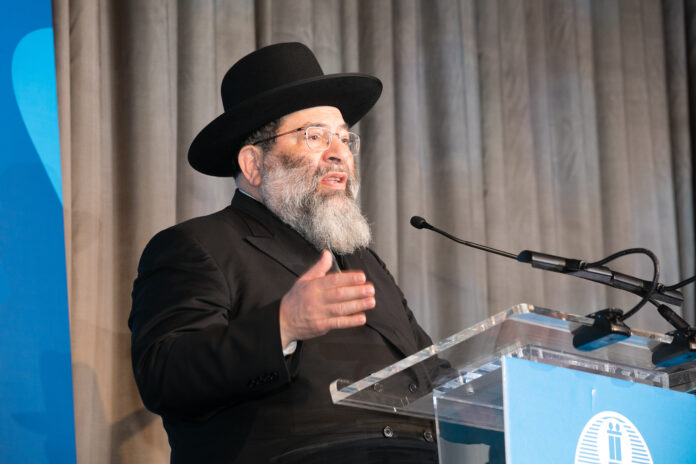
Rabbi Hamra, leader of New York’s Syrian Jewish community, stepped forward, heart pounding, hands trembling, the weight of Syria’s entire Jewish story pressed onto his shoulders. Cameras clicked. Aides froze. Every eye in the room locked onto the rabbi from Damascus who had left as a refugee and now stood before the head of the country.
“She’chalak m’Kvodo l’basar v’dam…” Rabbi Hamra exclaimed, translating its meaning to Arabic, before adding an additional blessing that Hashem should grant the president’s deepest desires in ways that will lead to genuine good and benefit for his people.
The president beamed. “Thank you.”
To understand the weight of that moment – the leader of the Syrian ex-pat community in New York blessing a man who spent years as a field commander within al-Qaeda and ISIS, who went from a most-wanted terrorist with a $10 million bounty on his head to becoming a head of state invited to the White House — you have to go back. Back to the stone alleys of the Jewish Quarter in the Old City of Damascus. Back to the shadow of the local prison. Back to the school where Rabbi Hamra taught for decades and the synagogue whose walls still held the echoes of his childhood prayers.
Before he became the rabbi offering blessings in Washington, Rabbi Yosef Hamra was a boy walking carefully through a country that watched his community with suspicion. Long before Rabbi Hamra stood before President Sharaa, he stood beside his brother, Chief Rabbi Avraham Hamra, in the Elfrange Synagogue, also known as the French Synagogue, in the Jewish Quarter of the Old City of Damascus where Rabbi Yosef served as chazzan, mohel, shochet, mesader kiddushin and everything the community needed him to be.
It was a world he never fully left. And it was in that world that the story begins to unfold.
We Missed You
“The Jewish Quarter was exactly the same as we left it,” says 77-year-old Rabbi Yosef Hamra, who fled Syria in 1992 during a short window when travel restrictions under Hafez al-Assad were loosened, and returned for the first time earlier this year, after the collapse of the Assad regime.
“Everything we remembered was still there,” Rabbi Hamra tells me this week, having returned to his Flatbush home after a most remarkable meeting in Washington.
Well, it was all still there, except the community itself, of which a mere six or seven individuals still remain.
Yet, as Rabbi Hamra stepped back into the Jewish Quarter for the first time in over three decades, the reaction, he says, was immediate. Word spread through the narrow streets faster than he could take his first few steps. Doors opened, faces appeared, and within moments people began pouring out of their homes and shops.
“The Jewish Quarter is not big,” explains Henry Hamra, the rabbi’s son, who’s been working closely with the Syrian government since the fall of the Assad regime. “Everybody knows everybody and word spread: ‘The rabbi is here, the rabbi is here,’ and they all came out to greet him.” Henry, who was 15 when he fled with his family and has traveled back several times over the last year (I joined him on one of those delegations), even ran in last month’s elections for a seat in Syria’s legislature.
The rabbi made his way to the old school building, the heartbeat of Jewish life in Damascus. This was where everything happened, where the community leaders kept their offices. If someone had a problem, they went to the school. If someone needed a din Torah, they came to the school. For decades, the daily rhythm never changed: As a young student and later, as a teacher for 30 years, Rabbi Hamra walked this same eight-minute trek every morning, greeted by neighbors leaning out of windows and waving across archways with warm calls of “Good morning, Rabbi!”
Now, the greetings were carrying a different weight; wistful, candid. “We missed you, Rabbi,” lamented one. “Without Jewish people, the Jewish Quarter is not worth anything,” admitted another.
On the walk toward the school stands a building that every Jew in Damascus once feared: the headquarters of the Palestinian Branch, a division of Assad’s secret police that was tasked with monitoring the community. Rabbi Yosef remembered how simply passing it was a harrowing experience, a reminder that eyes were always watching. And the dread only deepened each time someone from the community vanished behind its walls.
“Before Hafez Assad came to power in 1972,” Henry explains, “Jews were not even permitted to leave the Jewish Quarter. And even after 1972, anyone who tried to flee Syria could end up in this prison. It was the worst prison, just like what the world later saw at Sednaya.”
Sednaya, later exposed as one of Syria’s most brutal prisons, showed the world the kind of system Syrian Jews had lived under for generations. But earlier this year, on their first return to Damascus, they saw how the building that once terrorized generations stands abandoned and silent. Yet while the threat may be gone, the memory isn’t – it hit Rabbi Hamra like a wave he’d spent decades holding back. While the courtyard was now empty and the windows dark, in his mind the building was alive again: men in plain clothes — who needed uniforms when everybody knew who they were? — loitering near the Elfrange synagogue, drifting casually past the windows, pretending to stroll while listening for anything that sounded even remotely like disloyalty.
In his mind’s eye the year is 1969. It’s Simchat Torah. The shul is packed, the dancing wild, the voices pushing higher and higher. Someone starts a song; holy words, “Hashem Melech,” but to the wrong choice of melody. As the tune of Hatikvah cuts through the room, the secret police outside stiffen. “You are singing the national anthem of Israel!” one of them shouts as they barge in, the sting of his nation’s recent defeat in the Six Day War ringing raw.
They don’t ask who actually sang it. They grab 21-year-old Yosef Hamra and haul him out. He’d end up spending the next three days in a mountainside prison, visible from the hotel where they would now be staying during their visit. From there the images come in flashes: the beatings, the interrogators demanding he confess to working with the Mossad.
Then the memory shifts to whispered negotiations, relatives scraping together two gold coins (valued at $8,000 today) as a bribe to somebody inside the system. After three days that felt like a lifetime, he was free.
Standing there, on the same street, the building now empty and useless, the rabbi felt the past pressing against the present.
For Rabbi Hamra, the most emotional moment of his return came the instant he stepped inside the old synagogue. He lowered himself onto one of the familiar wooden benches, sat completely still, and let the years wash over him. For several minutes, he neither spoke nor moved. He simply absorbed the silence.
When I ask him to describe what that moment felt like, he pauses, and settles on just two words: “Nahat ruach.” A deep sense of inner peace that reaches the spirit and recharges the soul.
State of Fear
Before the exodus of 1992, before the airport lines filled with families clutching their suitcases and last hopes, Syrian Jews lived under a reality so fragile that a whisper could become a crime and a coincidence could become a death sentence. For decades, the community moved through life in a state of permanent caution, always aware that any misstep (or no misstep at all) could trigger that dreaded knock on the door or tap on the shoulder. These were not cautionary tales told to frighten children. They were lived realities. And long before Syrian Jews fled en masse, they already understood a painful truth: that their country could turn on them without warning.
One episode seared this lesson into the community’s memory: the arrest and public hanging of Israeli spy Eli Cohen in 1965.
The Jews of Damascus learned of it the way the entire nation did, when Syrian state television broadcast the arrest to millions.
“It was on TV. That’s how we found out about it,” Rabbi Hamra remembers.
To them, the name meant nothing. He was not one of theirs. “He wasn’t a member of the community. He never came to shul.” And yet, in a suffocating dictatorship, even a stranger could become your problem.
Cohen, traveling under a false identity, had passed through Damascus like any ordinary businessman. And when Syrian intelligence found a single receipt among his belongings, they converged upon the Jewish Quarter.
The secret police did not search for truth; they searched for culprits. First, they went to the shop and arrested everybody. The owner, the workers, and anyone nearby who simply breathed in the wrong direction.
That fear seeped into the bones of Damascus Jewry. It shaped how people spoke, how they trusted, how they moved through their own neighborhoods. It became the invisible backdrop to every holiday, every business transaction, every child walking to school. Rabbi Hamra recalls the tenseness of the first week after Cohen’s arrest, as neighbors hissed and cast angry glances in their direction.
Now, even decades later, the saga of Eli Cohen remains a sensitive subject. On my own visit to Syria in May of this year, I was cautioned not to speak his name out loud, and to maintain a low profile when we passed the spot of his execution. Henry expresses confidence that one day, his remains will be returned to Israel, but maintains that now it’s still a premature request.
If Eli Cohen’s arrest taught Syrian Jews how quickly suspicion could fall on the innocent, earlier traumas taught how cheaply their lives could be discarded.
One of the darkest memories dates back to the summer of 1949, when terrorists threw grenades into the Menarsha Synagogue in Damascus in the middle of Friday night services, killing 12 Jews – eight of them children. A simultaneous attack was also carried out at the Great Synagogue in Aleppo. The victims, Rabbi Hamra recalls, “were buried in one place,” both a marker of tragedy and a testament to a community that had learned to grieve quietly, quickly, and together.
The terrorists were caught, but later released due to lack of evidence.
Even childhood in Damascus carried an edge. The rabbi recalls that growing up, one great source of fear was the violent, hostile, Jew-hating youths who lived nearby. Their presence meant tension was never far away.
“Those kids used to bother us a lot,” he says. “They used to fight with us.”
In most instances, the secret police would intervene and break up the fights. Unless they were too slow to act. Two Jewish brothers were stabbed to death in 1964 when they were confronted by a gang. This was part of the steady stream of constant clashes that chipped away at any sense of childhood safety.
Among the stories whispered softly was the fate of six young people who tried to flee Syria in 1974. In those years, smugglers advertised themselves as guides who could slip desperate Jews across the mountains toward Lebanon or Turkey. Hope depended on such men. These young people — four Jewish girls, three sisters and a cousin, and two teenage boys — gathered jewelry, coins, and family valuables, and entrusted their lives to the wrong people. Turns out, these weren’t smugglers. They were predators.
Instead of guiding the youths toward a border, they led them deeper into the mountains, far from roads, witnesses, or help. There, in the isolation of the hills, they murdered and mutilated them. Their bodies were discovered by border police in a mountain cave. Syrian authorities deposited the bodies of all six in sacks and dumped them in front of their parents’ homes in Damascus’s Jewish Quarter.
Rabbi Hamra’s father was among those who tended to the victims afterward in order to give them a proper Jewish burial.
The murders sent a chill through every Jewish home in Damascus. If escape had been dangerous before, it now felt almost impossible.
It became yet another reason Syrian Jews lived with the caution they did, and it became one more reason that when the gates finally opened in 1992, they ran. Not because they wanted to abandon Syria, but because staying had long ago stopped feeling like survival.
Let their People Go
I ask Rabbi Hamra whether any happy stories had survived those years in Syria, and the rabbi’s wife calls out from the kitchen, “The happiest story was when Assad told us to go.”
It was Pesach of 1992, a holiday already heavy with symbolism of freedom, deliverance and the breaking of chains. For the Jews of Damascus, still trapped behind the walls of a police state, it had always been a reminder of what they didn’t have. But this night was different.
“Before breaking the matzah by Yachatz,” Rabbi Hamra relates, “my brother [Chief Rabbi Avraham Hamra] declared, ‘This is the last year.’ No explanation; no speech. The words landed like a question no one dared ask aloud.”
Only in the morning did the meaning begin to unfold. The chief rabbi stood up again, this time addressing everyone in the shul, and built on what he had told the family privately: “Anybody who wants to go, can go.”
The room erupted in confusion.
“Why? I have a house, I have a store… what are you saying?” people demanded. No one believed it. Not after decades of being forbidden to leave, not after generations of fear.
“On Chol Hamoed,” recounts Henry, who was 15 at the time, “we had a minhag that the community would come to the Rav’s house to wish him chag sameach. And that’s when he explained to everybody that Assad signed a law that everyone could leave.”
“Happy, happy,” interjects the Rabbanit. “That was a very happy story.”
I ask her if she joined her husband on that first trip back to Syria. “No. I was home that whole time, crying and crying. I was afraid.”
In the final weeks before the Jewish community left Syria, there was an unexpected surge of weddings. For years, Damascus had relied on Rabbi Yosef Hamra to perform marriages, with one additional rabbi able to assist when needed. Once the government gave permission for Jews to emigrate, both rabbis prepared to leave with their families.
That created an immediate problem: After their departure, there would be no one left in Damascus authorized to conduct halachic weddings.
With the community emptying rapidly and no possibility of bringing religious officials into the country, couples who had been planning to marry, and others who had postponed until a more stable time, suddenly faced a deadline. If they didn’t marry before the rabbis left, they would have to wait until they reached their new destinations abroad. Furthermore, married couples looking to start a new life in America could expect priority over singles.
To avoid that uncertainty, many couples chose to marry right away. The result was a concentrated wave of weddings – around 40 of them — in the final stretch before the exodus, ensuring that everyone who wanted to begin their new lives as married couples could do so before leaving Syria behind.
Grave Danger
Rabbi Hamra recalls the Arab–Israeli wars with a clarity shaped by fear and uncertainty. During the 1967 Six-Day War, he hunched over a radio, desperately trying to catch an Israeli broadcast through the static.
In 1973, he learned of the Yom Kippur War while walking to shul, hearing the news from local Arabs who blasted their radios at full volume. That Ne’ilah, he davened with the intensity of someone who had access to nothing but Arab propaganda and genuinely feared it might be Israel’s final Yom Kippur.
In both of those wars, there were locals who attempted to attack the Jewish community, but the Mukhabarat — the secret police — stepped in and stopped them. Still, even Succos that year became difficult, and securing arba minim was nearly impossible. And while they were happy for Israeli victories, “it was mixed with anxiety and fear over our own welfare,” says Rabbi Hamra.
Among the memories that remained with the community was an incident after the Six-Day War, when Syrian officials brought several bodies, supposedly of Israeli soldiers, to the Jewish leadership in Damascus. There were no details, only instructions.
“They told us to bury them in the Jewish cemetery,” remembers Rabbi Hamra. The community handled the burial respectfully, and Henry even shows me a home video of his father and uncle carrying the caskets to the cemetery.
Later, upon the realization that most of the soldiers weren’t Jewish, the government had them removed.
Rumors circulate from time to time that the body of Rav Chaim Vital, chief disciple of the Arizal, was secretly moved from Damascus to Israel. But Rabbi Hamra dismisses those rumors outright, citing a source whose word needs no embellishment.
“When the Baba Sali went to Damascus,” Rabbi Hamra notes, “he went to the kever of Rav Chaim Vital. If the grave had been empty, the Baba Sali would have said so. Instead, his visits and silences were a declaration of the opposite.”
A New Syria?
When asked about the most uncomfortable question in the room — whether President al-Sharaa, a former al-Qaeda and ISIS commander who put on a suit and became a head of state can truly be trusted, neither Rabbi Yosef nor his son Henry offer an opinion. They do not speculate, criticize or defend. Instead, they simply step around the political minefield entirely. Their posture suggests a different priority: looking forward rather than litigating the past. If there is a guiding principle, it resembles the old maxim of chabdei’hu v’chashdeihu, that is, respect but be on guard.
Their reluctance to pass judgment on al-Sharaa is not born of naivete, but rather reflects a deeper calculation. For the first time in decades, doors that were once sealed shut are cracking open, and the Hamra family, at least, is determined to keep those openings from closing. Their focus, they insist, is on practical steps that can improve the future for everyone instead of getting dragged into long-abandoned battlefields. And nowhere is that clearer than in the issue closest to the heart of Syrian-Jewish families: What has become of the homes, synagogues and properties they were forced to leave behind? Many Jewish families left Syria suddenly, unable to sell their homes, unsure of what would become of their belongings. Decades later, the situation remains unresolved.
“Many Jewish homes were left without being sold,” Henry says. “Some houses are rented out, taken over by caretakers who say they’re fixing them so they don’t fall apart.”
But there is no functioning Jewish communal authority to manage the legal side.
“There are only six or seven Jews left — nobody knows who’s responsible for anything,” he explains. “And the government doesn’t recognize the old organization’s documents anymore.”
When they fled, they never believed they would return, let alone reclaim anything they once owned. But history is full of unexpected openings.
In the past year, an idea has begun to take shape. What if Jewish properties in Syria could be returned?
And what if the synagogues, some of the oldest in the world, could be rebuilt?
It’s a possibility that may be whispered into reality by circumstances no one predicted: a Syrian president engaging with members of the Syrian-American community, and a rabbi standing face-to-face with the leader of the country he fled. In that moment, the unthinkable stopped being unimaginable.
Jobar, the ancient district on the edge of Damascus, became one of the fiercest frontlines of the Syrian Civil War. Rebel groups dug in early, and because the neighborhood sits in close proximity to the center of the capital, the Syrian army bombarded it relentlessly for years. Street-to-street fighting, artillery, and airstrikes leveled much of the area.
The historic Jobar Synagogue, one of the oldest in the world and traditionally linked to Eliyahu Hanavi, was caught directly in the crossfire and gradually destroyed. By the time government forces retook the district, little remained intact. Today, Jobar is largely uninhabited, its buildings gutted or collapsed, a stark reminder of how completely the war erased entire neighborhoods. Yet Jewish history in Jobar traces itself back more than 2,000 years. Its synagogue was a living relic, a place where Jewish memory and Syrian history intertwined.
During his return trip to Damascus, Rabbi Hamra told Deputy Foreign Minister Ahmed El Kanatri something he had long believed: “Eliyahu Hanavi protected this whole area. When they destroyed the synagogue, the whole area lost its protection.” The devastation was staggering. As many as 40,000 people – some say far more — were left without homes. When the Deputy Foreign Minister explained that the government’s priority was to rebuild the houses first, Rabbi Hamra offered a different order of operations entirely: “You have to repair the synagogue, and then everything else will be fine.”
Synagogues in Damascus were not mere houses of worship: they were community centers, judicial halls, gathering places and shelters from storms both literal and political. To rebuild them is to acknowledge that a community existed, that it mattered, that it suffered, that it has a rightful place in the story of Syria.
The goal, he admits, is not to repopulate Damascus with Jews. That era is gone. But to reclaim heritage. To restore what can be restored, to preserve what remains, to rebuild what was destroyed.
When I ask whether he believes there could once again be a thriving Jewish community in Syria, he looks up, smiles, and answers with a blend of Hebrew and Arabic hope, “With Mashiach, Insh’A-llah.” He then reaches for a sefer on a nearby shelf and points to the passage where Chazal teach that in the days of Mashiach, even Syria will become part of Eretz Yisrael.
“Come visit Syria,” Rabbi Hamra urges the Jewish Syrian youth who grew up in the Diaspora. “Come see where your ancestors lived. Come see the synagogue where your grandfather used to pray, where he used to sit. Maybe you have a grandparent who is buried in the cemetery. It’s very important.”
For Rabbi Hamra and his son Henry, the return of property and the rebuilding of synagogues is not about nostalgia. It’s about justice, dignity, and memory. What begins with a conversation and moves with a handshake, may end with a restored doorway in Damascus: one that opens not to a vanished past, but to a future where a community’s story is finally acknowledged. —
(Originally featured in Mishpacha, Issue 1087)



No comments:
Post a Comment