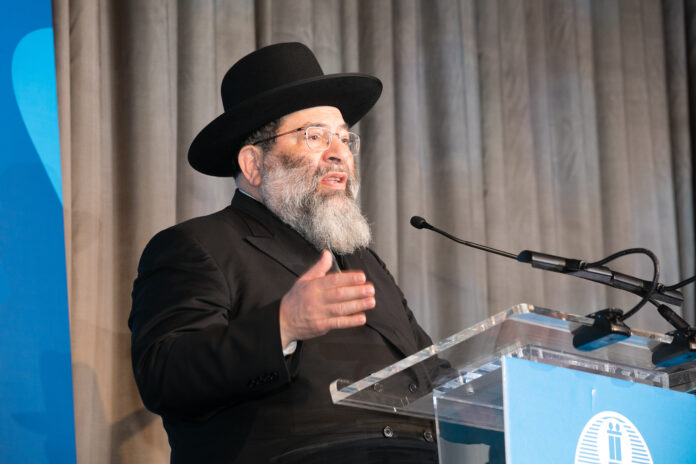
From the desk of Rabbi Shlomo Rizel(My Dad who should live and be well)


ב"ה

From the desk of Rabbi Shlomo Rizel

Icon
 
Candle Lighting Times for
Hebron
Friday, Nov. 14
 
4:08 pm

Message from the Rabbi

Dear Friends,

This week’s Torah portion tells the story of Eliezer, Abraham’s trusted servant, who was sent on an almost impossible mission to find a wife for Isaac in a faraway land. What’s fascinating is that throughout the entire story, Eliezer’s name is never mentioned. He’s simply called “the servant.”

That’s not an oversight, it’s the message. Eliezer didn’t see the mission as his project. He saw himself as a messenger, completely devoted to carrying out Abraham’s purpose. Because he didn’t make it about himself, he had the strength, clarity, and blessing to succeed.

This idea captures the essence of what will take place at the upcoming Kinus Hashluchim, the International Conference of Chabad Emissaries. Thousands of Chabad rabbis from every corner of the world will gather in Brooklyn this weekend, not for personal recognition or titles, but as humble “servants” of the same mission: to bring light, kindness, and Jewish connection wherever they are.

Each emissary, in their own city or country, faces enormous challenges. Yet like Eliezer, they succeed not because of their own power, but because they see themselves as extensions of something greater—Abraham’s legacy, the Rebbe’s vision, our collective Jewish soul.

In a world that often celebrates ego and self-promotion, the Kinus reminds us that true greatness lies in humility and purpose; in knowing that we are part of something infinitely bigger than ourselves.

Shabbat shalom from New York City,

Rabbi Rizel


Parshah in a Nutshell


Parshat Chayei Sarah

The name of the Parshah, "Chayei Sarah," means "The life of Sarah" and it is found in Genesis 23:1.

Sarah dies at age 127 and is buried in the Machpelah Cave in Hebron, which Abraham purchases from Ephron the Hittite for four hundred shekels of silver.

Abraham’s servant Eliezer is sent, laden with gifts, to Charan, to find a wife for Isaac. At the village well, Eliezer asks G‑d for a sign: when the maidens come to the well, he will ask for some water to drink; the woman who will offer to give his camels to drink as well shall be the one destined for his master’s son.

Rebecca, the daughter of Abraham’s nephew Bethuel, appears at the well and passes the “test.” Eliezer is invited to their home, where he repeats the story of the day’s events. Rebecca returns with Eliezer to the land of Canaan, where they encounter Isaac praying in the field. Isaac marries Rebecca, loves her, and is comforted over the loss of his mother.

Abraham takes a new wife, Keturah ( Hagar), and fathers six additional sons, but Isaac is designated as his only heir. Abraham dies at age 175 and is buried beside Sarah by his two eldest sons, Isaac and Ishmael.

Learn: Chayei Sarah in Depth
Browse: Chayei Sarah Parshah Columnists
Prep: Devar Torah Q&A for Chayei Sarah
Read: Haftarah in a Nutshell
Play: Chayei Sarah Parshah Quiz


Rabbi Shlomo Rizel

During these difficult times you are not alone. If you need to speak with someone or need assistance, please click here to email one of our staff Remember Hashem loves you!


Tefillin for the IDF

Click to Donate to support providing tefillin to the IDF.

Click Hereto Donate


This Week @ www.chabad.org

  
By the Numbers
10 Mainstream and Mysterious Torah Works by Anonymous Authors
Some surprisingly famous texts were written without the author’s name attached.
  
The Freeman Files
My 4,000-Year-Old Message to 2,500 Jewish Students in NY
To be a Jew today, you gotta be a leader.
  
Your Questions
Why Do We Bury Jewish Books?
By honoring these remnants of holiness, we remind ourselves that the Divine is not confined to heaven above.
  
Podcasts
The Boy From the Outback
Artist Yitzchok Moully shares his journey from an Australian commune to Crown Heights, his Chassidic-inspired art, and how creativity ignites Jewish pride and resilience.

Today's Quote

When the Children of Israel stood at the shore of the sea and saw the Egyptian armies closing in behind them, they split into four groups. One faction said, "Let us cast ourselves into the sea." A second faction said, "Let us return to Egypt." A third said, "Let us wage war against the Egyptians." A fourth said, "Let us cry out to G-d." But G-d rejected all four approaches and said to Moses, "Speak to the children of Israel, that they go forward."
— Midrash Mechilta

Chabad World News


Comments

Popular posts from this blog

HECKLER IN THE HEIGHTS

Is It Proper For A Man To Wear A Wedding Band?

Studies Show Jews’ Genetic Similarity