Next Door to Greatness

While 12 years have passed since Chacham Ovadiah’s petirah, Rabbi David Shelby still feels as connected as ever

Photos: Itzik Roytman, Mishpacha archives
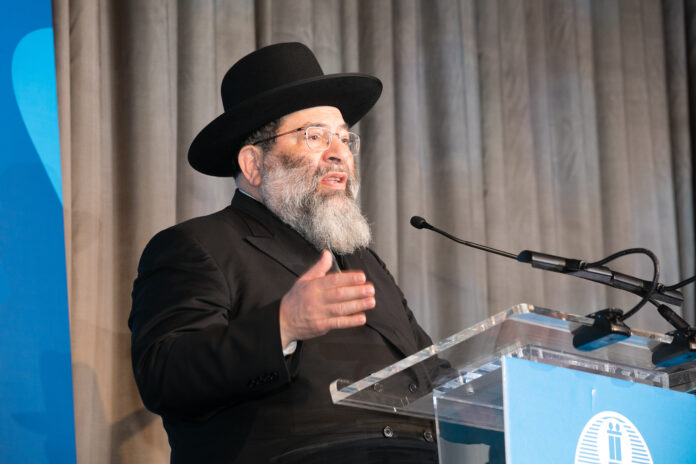
American-born David Shelby had been an admirer of Rav Ovadiah Yosef since he was a child. Then, when Rabbi Shelby became the Chacham’s neighbor and joined his exclusive kollel, he turned into family. And while 12 years have passed since Chacham Ovadiah’s petirah, Rabbi Shelby still feels as connected as ever
Rabbi David Shelby, the rabbi of Congregation Shaare Shalom in Brooklyn, was just about five years old when he first met Chacham Ovadiah Yosef, and the seeds of a relationship sprouted. Over the years, that connection intensified manifold.
“He was my oxygen,” he says. “My family and I are still completely infused with him.”
The screen on his cellphone is a photo of him with the gadol, and in his wallet he carries a laminated 20-shekel note that Chacham Ovadiah once gave him. In the living room of his Brooklyn home, the only picture on the wall is a portrait of Chacham Ovadiah. The basement is filled with documents, seforim, photos, and memorabilia. The only thing missing from his trove is a photo of a silver kamaya, containing various names of Hashem and malachim, that Rabbi Shelby once noticed on Chacham Ovodiah’s desk. It was such an uncharacteristic item that he took a picture of it and made a copy for posterity. But when he got back to the US, the paper had mysteriously disappeared.
Rabbi Shelby’s veneration of the Chacham comes from up-close-and-personal experience. After his wedding, Rabbi Shelby lived next door to Chacham Ovadiah for nine years and joined his kollel, developing a close, familial relationship. Even after moving back to the US, he flew to Eretz Yisrael to visit his rebbi numerous times a year. And while 12 years have passed since Chacham Ovadiah’s petirah on 3 Cheshvan in 2013, in his heart, Rabbi Shelby still feels as connected as ever.
Every Opportunity
Voluble yet self-effacing, Rabbi Shelby’s soft, friendly manner masks the talmid chacham underneath.
“My father will never tell you this himself, but he is a tremendous talmid chacham, and received semichah from Chacham Ovadiah,” says his son Rabbi Pinchas Shelby.
As a bochur, the young David Shelby voraciously devoured all of Chacham Ovadiah’s writings, scouring bookstores for his pamphlets, books, and other paraphernalia. He took every opportunity to go to see him. And after his marriage to Chani (nee Haber), he had the good fortune of finding an apartment at Rechov Hakablan 47 in Har Nof, just one building over from Chacham Ovadiah, who lived in Hakablan 45.
Rabbi Shelby’s father, Philip (Pinchas) Shelby a”h, provided a vivid example of the importance of becoming close to a gadol. The senior Shelby became very close to Rav Avigdor Miller long before he was well-known — and ultimately was a conduit to propagate his Torah.
“My father came from a regular, traditional Syrian family. He himself attended public schools and had a jewelry business in the city,” Rabbi David Shelby relates. “One day, he went to pray in the Mirrer yeshivah, and someone told him, ‘There’s someone you should learn with.’ That person was Rabbi Miller. They began learning, and soon other people joined, and before long it turned into a shiur that kept growing.”
Phil Shelby helped establish Rabbi Miller’s shiurim in the Young Israel shul on Ocean Parkway and came up with the idea of taping and distributing the lectures. The enormous impact of that initiative was acknowledged by Rabbi Miller himself in the introduction to his 300th lecture.
“We should remember that this entire institution was started by one man — Pinchas Shelby. He was the one who thought this up, from the very beginning. Not only that, he came every Thursday night with his car to pick me up and he took me home after the lecture. And it cost him a lot of money, week after week, because there were expenses involved here. And then it was his initiative to spread the tapes to the world…. It was his vision from the beginning; he thought about it before anyone else did.” (Quoted in Sunset: Special Publications by Toras Avigdor in honor of the 20th Yahrzeit)
Phil Shelby became more observant at a time when few Sephardic Jews in the US had a yeshivish hashkafah.
“Even before he was strictly frum, he sent my brothers and me to Torah Temimah and the Mirrer Yeshiva; he didn’t want us in coed schools,” Rabbi Shelby says. His father was also a pioneer in terms of his attachment to Eretz Yisrael. As far back as the 1970s, when not many Americans traveled there regularly, he took his family there often.
It was on one of these trips that Rabbi Shelby had his first encounter with Chacham Ovadiah.
“We were in Israel, and my family was going on a tour, but my brother Michael and I weren’t interested,” he relates. “My grandfather stayed behind with us and took us to see Chacham Ovadiah. He was wearing his rabbinic robe with the embroidery, and I stood next to him. I was mesmerized. He seemed like an angel of Hashem.”
A couple of years later, he went with his family to the Ahi Ezer synagogue on Ocean Parkway to see the Chacham, who was visiting. The synagogue hosted a gala celebration, and again, the young David was enraptured.
Over the years, David’s family would sometimes spend Succos in Yerushalayim. They would stay in an apartment on Ben Maimon Street in Rechavia and pray in the small section of the Great Synagogue reserved for a Sephardic minyan. “I would walk to the Great Synagogue every morning to pray with the Chacham — even all by myself,” he remembers. (Before Rav Ovadiah moved to Har Nof, he lived on Rechov Jabotinsky.)
When David finished mesivta, he went to learn in Yeshivat Mikdash Melech in Jerusalem. There he availed himself of every opportunity to acquire Chacham Ovadiah’s writings and see him whenever possible. After he bought the first volume of the Yalkut Yosef (a halachic work begun by Chacham Ovadiah but finished by his son Rishon LeTzion Rav Yitzchak Yosef shlita), he and his good friend Freddy Rudy decided they’d stay up for an all-night mishmar to learn it, then go to daven with Chacham Ovadiah in his home. (“In order not to waste time going back and forth, Chacham Ovadiah always had a minyan in his house,” Rabbi Shelby explains.)
When they arrived at the apartment early in the morning and knocked, no one answered. David went off to ask the Chacham’s driver if he knew where he was, and when he came back, Freddy had disappeared.
A few minutes later, Fred appeared, beaming, holding a signed copy of the Yalkut Yosef volume. Chacham Ovadiah had been there all along; he simply didn’t hear anything when he was learning. Someone else had finally let him in. Five minutes later, David knocked again. This time he got in, and Chacham Ovadiah signed the sefer for him, the first of dozens of seforim that Chacham Ovadiah would inscribe for him.
“I’ll tell you how oblivious he was to everything when he learned,” Rabbi Shelby says. “I brought men from the community to him often, and once I took a group of guys from Ahaba Ve Ahva, the Egyptian shul. This was in the early days of cell phones, but these men were ahead of the game and they all had phones with Facetime. It was 1:00 a.m., and they were busy Facetiming their wives to show them they were with Chacham Ovadiah, but he had no idea they were there. He was too absorbed in his learning.
“I saw this happen dozens of times. It was only when he reached to get a book that he looked up and said, ‘What are all you men doing here?’ But once he was aware of their presence, he graciously blessed every one of them.”
In Geula, Rabbi Shelby once found a copy of the Chacham’s pamphlet Yabia Omer, written when he was only 17. He brought it to a preservationist in Yad Vashem to protect the pages and added a cover. Then, 70 years after its publication, he brought the copy to Chacham Yosef. “Where did you get this?” the Rav marveled. “And how much did you pay for it?”
When Rabbi Shelby told him the price, he laughed. “If I’d known it would sell for so much, I would’ve printed a lot more!” he said.
Into the Desert
When David Shelby was offered a shidduch with Chani Haber, the daughter of Rabbi Michael a”h and Molly Haber, he accepted with one condition: He wanted Chani to commit to spending three years in Jerusalem while he learned in kollel. Chani, who had been born in Jerusalem, understood the concept; her parents had done the same thing.
Chani’s parents as role models notwithstanding, when the Shelbys got married, it certainly wasn’t common for young Syrian newlyweds to spend several years learning in Eretz Yisrael.
“My wife followed me into a midbar,” Rabbi Shelby says. “She had no family there, except for a sister who came for a short while, and she didn’t know a soul.”
Chani was moser nefesh for her husband’s Torah, mostly left on her own while he learned.
“My husband would leave the house early in the morning and often wouldn’t get home till midnight,” she relates. But she managed, while opening their home on Shabbos to any American Sephardi boys they knew. At night, when her babies would wake her up, she would see the lights on in Chacham Ovadiah’s window, which faced her own.
“He would turn them off around 3:00 a.m., and by 6:00 a.m. he would be up again,” she recalls.
“Sometimes he completely forgot to sleep,” Rabbi Shelby says. “He would forget to eat, too.”
David Shelby was dead set on joining Chacham Ovadiah’s kollel, even though no Americans had joined to date. There was an entrance exam he had to pass, and he spared no effort to do so.
“He studied so hard, and was so nervous, that he made himself physically ill,” Chani says. But he passed, and joined the kollel, whose regimen was so rigorous that Rabbi Shelby often saw his wife only 15 minutes a day. An old photo from the 1980s shows David Shelby with his Israeli kollel colleagues, his grey pants and jacket a sharp contrast to their black suits.
Rabbi Shelby remembers how one Motzaei Shabbos he was reading from Chacham Ovadiah’s sefer on Pirkei Avos, when he came to a passage that said that tzedakah and Torah are two things that remain with a person, and that a person’s forehead is the screen of his soul. At that moment, someone knocked on the door, collecting tzedakah for someone the Shelbys knew.
“We weren’t living a luxurious life,” Rabbi Shelby relates. “But the situation was very serious, so I gave more than usual. The man hugged me warmly and left.
“I remarked to my wife, ‘I guarantee you that tomorrow, when I come into Chacham Ovadiah’s house for minyan, he’ll call me to sit next to him, because he’ll know I gave a little more tzedakah than was expected.”
The following morning, Rabbi Shelby woke up uncharacteristically late. “I missed my chance!” he groaned. But he went to the minyan in the Yosef home anyway. Standing in the back, he was putting on his tallis and tefillin when he heard something.
“Chacham Ovadiah never spoke during the tefillah,” he says. “But that morning, he motioned firmly to me to come sit next to him.”
Every Motzaei Shabbos, Chacham Ovadiah would give his famous shiur in the Yazdim shul in Jerusalem’s Bucharim neighborhood. “He had started the shiur there fifty years prior, and refused to change the venue out of hakarat hatov,” Rabbi Shelby says. “We always came an hour or two early to get the best seats, because the shul would fill up with 2,000 people, upstairs and downstairs and pushing against the windows outside.”
One of the yungeleit arranged for live satellite transmission of the class to France, Italy, and England. The shiur was also taped and sent via FedEx to the Bnei Yosef synagogue in Brooklyn, where each Motzaei Shabbat, people would watch the previous week’s class, translated by a young Rabbi Eli Mansour. Over 100,000 people around the world watched those classes.
Upon getting wind of the reach of Chacham Ovadiah’s shiurim, the Coca Cola company offered to pay him a nice sum if he would place a can of Diet Coke on his desk while speaking. But the Chacham would have none of it. “Absolutely not!” he said. “Torah is not a business.”
A Son of Two Fathers
Rabbi Shelby was so attached to Chacham Ovadiah that his own father used to say, “I’m your biological father, but Chacham Ovadiah is your father.”
Chacham Ovadiah returned his affection, calling Rabbi Shelby “HaDavid shelanu.” He would often say “Rebbi David, ani ohev kemo ben — I love Rebbi David like a son.”
When the Shelbys had their first son, they faced a dilemma. According to Syrian custom, a couple’s first boy is named after the paternal grandfather, and that grandfather is given the honor of serving as sandek at the bris. Rabbi Shelby wanted to give his father the kavod that was due to him, yet he also yearned for his rebbi to be his child’s sandek.
In the end, the choice was made for him. The bris fell out on Yom Kippur, and Chacham Ovadiah left home to join the minyan at the Great Synagogue. “I believe he didn’t want to take away my father’s kavod,” Rabbi Shelby says.
That child, Rabbi Pinchas Shelby, who would sit on his father’s knees next to Chacham Ovadiah every Friday night as a young child, imbibed a love for seforim from his father and Chacham Ovadiah. He has written and published his own works and others, including updating and reprinting the classic sefer Yonas Eilem by Rav Yonah Minsker.
The Chacham treated the Shelbys like family. Rabbi Shelby remembers how on a visit to the Yosef home with his son Pinchas, about a year or two before the Chacham passed away, they ate all three Shabbat meals there. During one meal, Rav Ovadiah called out, “Pinchas, tochal! Taaseh kemo habayit shelcha! — Pinchas, eat! Make yourself at home!”
Whenever Rabbi David Shelby visited, the Chacham would always send treats for his family.
“My father had once gone to the Baba Sali for a brachah for an aunt who had epilepsy, and he asked him to bless a bottle of water for her. That gave me the idea to ask Chacham Ovadiah to bless some candies for my wife and children,” Rabbi Shelby says. “After that, every time I came in from the States to visit, he would ask his son for candies before I left and bless them for us. In fact, I visited around three weeks before he was niftar, and he was in a hospital bed attached to an IV, with doctors around him. I was preparing to leave when he cried, ‘You didn’t take a candy!’ He took a sugar-free Must candy from his drawer (candies he used to help alleviate the taste of unpleasant medications), and gave me one.”
Chacham Ovadiah had warm feelings for Rabbi Shelby’s father, and prayed for 20 years for his welfare. Ultimately, Mr. Shelby was niftar just a few months after Chacham Ovadiah. It was a devastating year for Rabbi Shelby.
“I lost two fathers at once,” he says.
The Shelbys had been living in the US for 11 years when Chacham Ovadiah was niftar. Shortly afterward, Rabbi Shelby’s friend Nathan Rudy (a brother of the aforementioned Fred Rudy) visited his kever in Sanhedria. He called Rabbi Shelby and asked, “What should I tell him?”
“Tell him I’m doing well,” he replied. “Tell him, ‘I need a sign you’re not leaving me!’ ”
“That’s a little strong,” his friend said honestly, but did as he was asked.
An hour or so later, a picture suddenly popped up on Rabbi Shelby’s phone. It was a picture of himself with Chacham Ovadiah, sent to him randomly by the Chacham’s young granddaughter. She had gone to work early, and when she turned on her computer, the photo popped up in one of her feeds, and she immediately sent it on to him. “It’s been the wallpaper on my phone for the last twelve years,” he says.
Long-Distance Devotion
After about nine years in Eretz Yisrael, Chacham Ovadiah told Rabbi Shelby it was time to return to his community and give back by teaching Torah. The Shelbys were hesitant to go, but Chacham Ovadiah was firm in his decision and hosted a large, catered seudas preidah for them.
Back in the US, Rabbi Shelby was hired to teach in Magen David Yeshivah, led by Chacham Baruch Ben Haim, a close friend of Chacham Ovadiah. (Chani also began teaching in various schools and is today the principal of the Shaare Binah seminary in Brooklyn.)
Once in America, the Shelbys were determined to spread Chacham Ovadiah’s Torah and bring students back to meet him. Believing she could not properly serve as a representative of the Chacham with a wig on her head — as Chacham Ovadiah was strongly opposed to them — Chani abandoned the expensive sheitel she’d bought as a kallah in favor of a headscarf.
For the next 20 years, Rabbi Shelby traveled to Israel every Yom Kippur, and every few months. The principal of Magen David once objected. “You can’t go again. I can’t give you the time off!” He relented on the condition that Rabbi Shelby bring back a video of Chacham Ovadiah addressing the school.
Rabbi Shelby went to his rebbi and informed him of the condition of the visit. “Let’s do it now,” Chacham Ovadiah said. “Get my robe.” He refused to be wait, despite Rabbi Shelby’s protests that it could wait till the end of the visit.
“He met thousands of boys,” Rabbi Shelby remembers. “I brought him boys who were struggling with religion. There was one who was suffering after his parents’ divorce, living in poverty and dabbling in drugs. Chacham Ovadiah pounded the boy’s chest while giving him a ten-minute-long brachah, and today that young man is in kollel.”
He remembers only one time when Chacham Ovadiah refused a request of his. He asked the Chacham to take part in a video promoting what Rabbi Shelby thought was an incredible initiative. In an unusual move, Chacham Ovadiah said, “Come tomorrow.”
The next day, they were in an elevator alone, and Rabbi Shelby ventured, ‘The Rav doesn’t want to do it, right?’
Chacham Ovadiah replied, “This is no organization. This fellow is lining his own pockets with the money.”
Dreams and Doves
Chacham Ovadiah once dreamed that the Rambam came to him and said, “Look at the spiritual situation of Am Yisrael. Why are you sleeping?” The Rav dismissed it as a dream and went back to sleep. But then he had the same dream again — and then again. The third time, he rose from his bed and went to go learn.
The Rambam wasn’t the only Torah giant who came to him in a dream. One day, Rabbi Shelby and Chacham Ovadiah’s driver heard him give a sudden, uncharacteristic giggle, his sense of humor notwithstanding. When asked what was funny, he said, “I stayed up all night trying to resolve a contradiction in the Chida. I was successful, and the Chida came to me in a dream to thank me.”
Rabbi Shelby explains the backstory: The Chida wrote many seforim during his long lifespan. A statement he made in an early book seemed to be contradicted by a statement in a much later book.
“Chacham Ovadiah determined that the two instances referred to two different scenarios, and did not actually contradict each other,” he says. “That night, he had a dream in which the Chida came to him to thank him.”
Another time, after the kollel had just finished a difficult bechinah, the Chacham told the avreichim to take the rest of the day off and spend it knocking on doors teaching children to say Shema Yisrael.
“This was unheard of,” Rabbi Shelby says. “Chacham Ovadiah had no concept of vacation, of bein hazmanim. A person learns Torah without stopping. We used to have two days off the whole year, Erev Kippur and Erev Pesach. When we asked him to explain, he said that the previous night, he had dreamed of Mashiach.”
Chacham Ovadiah related, “Last night I had a dream that there were hundreds of thousands of Jews at the Kotel, and Mashiach came. All the gedolim were seated at a table, and Mashiach was at a podium thanking all the people who had helped be mekarev people. I was sitting at the table and I got up and walked over to him and said, ‘I never saw you before, but obviously you are Mashiach. But why is this just a dream? Why aren’t you really here?’
“Mashiach answered, ‘Because there are over a million children in Eretz Yisrael that don’t know Kriat Shema, so how do you want me to come?’ ”
Upon hearing this, Chacham Ovadiah’s son Rabbi Moshe protested, “Abba, you always tell us that dreams don’t mean anything. Why are you making a big deal out of this dream?”
The Chacham replied, “If you had felt what I felt during this dream, you would have also believed it.”
Chacham Ovadiah often seemed to be followed by white doves.
“One Erev Rosh Hashanah,” Rabbi Shelby says, “I was present when Chacham Ovadiah went into shul, and a white dove followed him in. Unperturbed, he continued into the shul, where the dove circled his head three times and then landed upon his shtender. Chacham Ovadiah approached the bird and said something in its ear. The dove then flew out of the shul.
The Torch Still Burns
The last couple years of Chacham Ovadiah’s life were marked by numerous health challenges, and when he was niftar, the entire Jewish world mourned. “He taught all people; he helped all people,” Rabbi Shelby says.
Chacham Ovadiah did much to restore the dignity and religious level of the Sephardic world, but people from all segments of Klal Yisrael loved and respected him. His funeral, attended by a crowd estimated to number over 850,000 people, was the probably the largest in Klal Yisrael’s history. “It was so crowded, yet not a single person was injured,” Rabbi Shelby notes.
In Eretz Yisrael, his legacy is perpetuated by his sons, including Rav Yitzchak Yosef, who served as Rishon L’Tzion from his father’s passing until 2024, and Rav David Yosef, who took over as chief rabbi after that. But in the US, the young boy who walked through the cobblestone streets of Jerusalem to internalize the impression of an angel, is the one who continues to spread his Torah and educate a younger generation about exactly who he was and what we have lost.
“I miss him dearly every day,” Rabbi Shelby says, “but his legacy is eternal.”
His Helper in Both Worlds
BYthe time the Shelbys settled in Israel, Chacham Ovadiah’s wife Rabbanit Margalit had passed away. Chacham Ovadiah’s son Rabbi Moshe and his wife Yehudit had moved in to care for him.
Chacham Ovadiah missed her greatly. “When he would sing Eishet Chayil on Shabbat, he would cry sometimes,” Rabbi Shelby says. “He credited her with everything he achieved.”
When the young Margalit first met her chattan, she was not impressed. He had little to say, as his mind was only occupied with Torah, and she left the meeting early.
He refused to be discouraged. He knew she was the daughter of Chacham Avraham Fattal of Aleppo and would be able to appreciate a life of Torah. He followed her to her home, where he begged her father to let him speak to her for just two minutes. “Hashem blessed me with a phenomenal memory,” he told her. “I know that one day I will be a leader, and I need you to be my partner.”
“Chacham Ovadiah always knew this was in his future,” Rabbi Shelby recounts. “When he was nine or ten years old, he used to draw pictures of the Chief Rabbi in his garb, and he made book stamps with his name and the words Rishon L’Tzion.”
Chacham Ovadiah’s wife and children lived with a mesirus nefesh that was truly next-level. Margalit would go to the Machaneh Yehudah market — at the time was a far cry from the gourmet venue it is today — and forage for discarded scraps of food on the floor. Sometimes the family would go without milk because Chacham Ovadiah had used the money to buy a sefer.
For years, he himself would eat nothing more than a slice of bread with a piece of tomato the entire day. “His big Rosh Chodesh treat was to allow himself a small cup of sour cream,” Rabbi Shelby says.
Chacham Ovadiah’s beloved chaver and classmate from Yeshivat Porat Yosef, Chacham Baruch Ben Haim, eventually moved to the US, where he became the Chief Rabbi of the Syrian community. He taught in Yeshivat Magen David and established the Torah Center at the Shaare Zion synagogue. “When he received his first paycheck in America, he immediately sent money to Chacham Ovadiah,” Rabbi Shelby says. “But money meant nothing to him.”
The Rabbanit never left her husband alone, but one day her children convinced her to come to Tel Aviv on a shopping trip. She left a pot of a dozen yebra (stuffed grape leaves) and made her husband promise he would eat them. When she returned, the yebra were still there. “Why didn’t you eat?” she said.
“I did eat, I ate from the pot,” he said. His wife had covered the yebra with extra grape leaves so that they wouldn’t dry out, but Chacham Ovadiah, oblivious to what he ate, mistook the leaves for his meal.
Ever since his bar mitzvah, the Chacham had the custom to make 100 brachos every day. On Yom Kippur (as well as each Shabbas and Yom Tov) he made up for the brachos he missed with various forms of blessings on besamim. But the Yom Kippur after the Rabbanit was niftar, Chacham Ovadiah’s driver did not bring him the besamim as he usually did, too stymied by the prospect of having to face the Rav and offer condolences after such a terrible loss . That Yom Kippur, the Chacham did not manage to make all 100 brachos.
That night, the driver dreamed that the Rabbanit came and rebuked him. “How could you do this to my husband? He missed his hundred brachot because of you!” she cried.
When the driver later related this to Chacham Ovadiah, he cried. “You see?” he said. “My wife took care of me during my lifetime, and she is even taking care of me after her petirah.”
(Originally featured in Mishpacha, Issue 1084)
RELATED CONTENT

A father-son reunion, and lessons of light shining out of the darkest places

Manchester’s Rabbi Daniel Walker remembers those murdered on the holiest day of the year — and is determined to rebuild


Four fathers of hostages share their dreams, faith, and struggles that no parent is ever prepared for

He beat his stutter with a tech invention. Then he found the voice to help others

Along his path to wealth, Eliyahu Kholodenko learned that money isn’t the bottom line




No comments:
Post a Comment